Sacred Bridge
- Medium:
- Woodblock print
- Publisher:
- Yoshida Studio
- Source:
- ukiyo-e.org
Typical Price
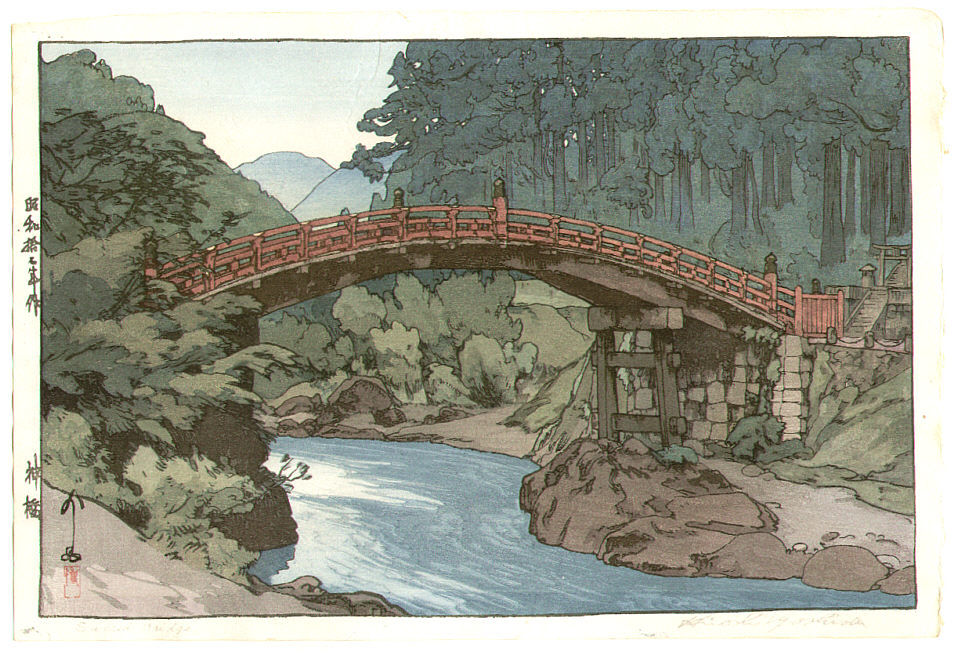
The Sacred Bridge (Shinkyo) at Nikko is one of Japan's most iconic landmarks, and Yoshida's rendering emphasizes the vermillion lacquer arch against its forested gorge setting. Jizuri editions command $2,000-$5,000, with the vivid red bridge color requiring strong impressions to achieve full impact. Studio editions sell from $900-$2,500. This is one of Yoshida's most recognizable and frequently reproduced compositions.
Description
Sacred Bridge depicts the iconic Shinkyo bridge at Nikko, one of Japan's most revered Shinto sacred sites and a subject that held deep personal significance for Hiroshi Yoshida. The vermillion-lacquered bridge arches gracefully over the Daiya River, its bold red form creating a striking contrast against the lush green foliage of the surrounding cedar forest and the blue-gray tones of the rocky riverbed below. The bridge's elegant curve, reflected in the flowing water beneath, creates a composition that balances architectural precision with natural beauty.
The Shinkyo bridge, whose name literally translates as "sacred bridge," marks the traditional entrance to the Nikko shrine complex and is associated with the legend of the priest Shodo Shonin, who is said to have crossed the river on the backs of two serpents at this spot in the eighth century. The current bridge structure dates to 1636, when it was rebuilt as part of the grand expansion of the Toshogu shrine complex dedicated to Tokugawa Ieyasu, the founder of the Tokugawa shogunate.
Nikko was a subject to which Yoshida returned repeatedly throughout his career, drawn by the extraordinary combination of elaborate architectural ornamentation and pristine mountain forest that characterizes the shrine complex. His Nikko prints form an informal series that includes views of the Yomei Gate, various temple buildings, and the surrounding landscape, all rendered with the careful observation and atmospheric sensitivity that define his mature style.
The printing of Sacred Bridge required careful management of the contrast between the brilliant vermillion of the bridge and the more subdued natural tones of its setting. The red pigment had to be applied with sufficient intensity to convey the lacquered surface's vivid color while remaining harmonious within the overall composition. The water flowing beneath the bridge was rendered with characteristic skill, using overlapping translucent impressions to suggest depth and movement. The cedar trees framing the scene were built up through multiple green and brown printings, creating the dense, layered quality of an ancient forest.