Hirosaki Castle, from the series "Eight Views of Cherry Blossoms"
- Series:
- Eight Scenes of Cherry Blossoms (print 1 of 8)
- Date:
- 1935
- Medium:
- Color woodblock print
- Format:
- Oban
- Dimensions:
- 26.4 × 40.5 cm
- Publisher:
- Yoshida Studio
- Source:
- Art Institute of Chicago
Typical Price
Hirosaki Castle framed by cherry blossoms is one of the most picturesque compositions in the Eight Views of Cherry Blossoms series, combining a northern Japanese castle with the ephemeral beauty of spring. Jizuri editions sell for $2,000-$5,000, benefiting from the Hirosaki cherry festival's modern fame. Studio editions range from $900-$2,500. This is consistently one of the more popular prints from the cherry blossom series.
Description
Hirosaki Castle is a beloved print from Hiroshi Yoshida's Eight Views of Cherry Blossoms series, depicting the famous castle in Aomori Prefecture framed by clouds of blossoming cherry trees in full bloom. The composition captures the quintessential Japanese spring scene: the castle's distinctive three-story keep rises above a stone foundation wall, while cascading branches of pale pink sakura blossoms fill the foreground and middle ground, their delicate petals creating a soft, dreamlike canopy over the castle moat. The still water below reflects both the architectural forms and the flowering branches, doubling the visual richness of the scene.
Hirosaki Castle, built in 1611 by the Tsugaru clan, is renowned today as one of Japan's premier cherry blossom viewing destinations, with over 2,600 cherry trees planted throughout its grounds. Yoshida's print captures this reputation perfectly, presenting the castle not as a military fortification but as a setting for the contemplation of natural beauty — a transformation that mirrors the broader cultural shift in how Japanese castles came to be perceived during the modern era.
The Eight Views of Cherry Blossoms series represents Yoshida's engagement with one of the most symbolically charged subjects in Japanese art. Cherry blossoms carry profound cultural significance as emblems of beauty, transience, and the Buddhist concept of mono no aware — the bittersweet awareness of impermanence. By creating an entire series devoted to cherry blossoms at different locations, Yoshida followed in the tradition of Japanese artists who organized works around seasonal and geographic themes while bringing his distinctive naturalistic approach to the subject.
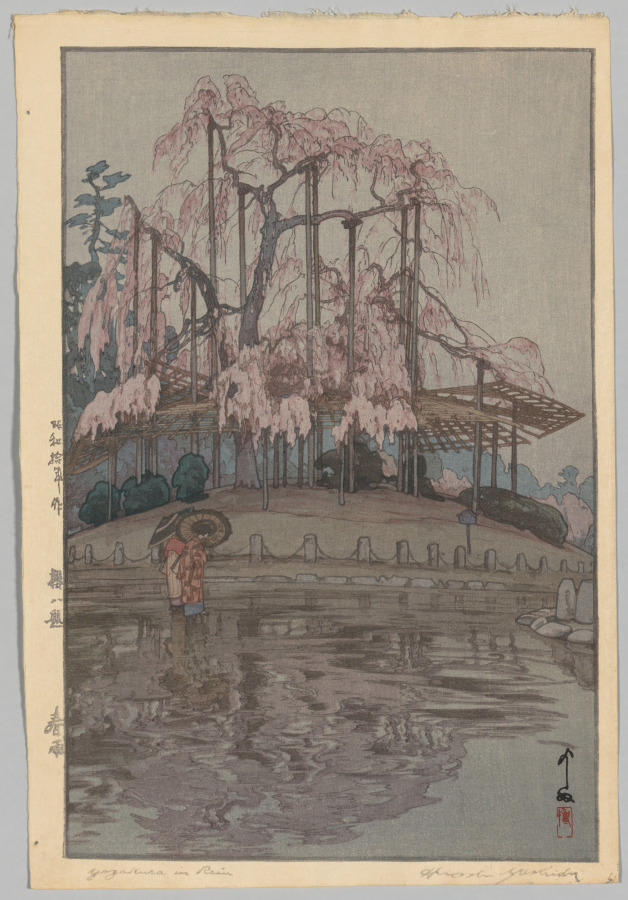
The technical challenges of depicting cherry blossoms in woodblock printing are considerable. Each blossom cluster required careful carving to maintain the impression of individual flowers within a larger mass, and the pale pink tones demanded precise pigment mixing and controlled application to avoid appearing either too vivid or too washed out. Yoshida's printers achieved a remarkable softness in the blossom passages, contrasting effectively with the harder geometric forms of the castle architecture.