![A Little Restaurant [at Night] (Ryoriya no yoru) by Hiroshi Yoshida — Japanese Color woodblock print; oban, 1933](https://www.artic.edu/iiif/2/e0e87290-6b97-4999-6986-731f7a56bbc9/full/843,/0/default.jpg)
A Little Restaurant [at Night] (Ryoriya no yoru)
Ryoriya no yoru
- Date:
- 1933
- Medium:
- Color woodblock print; oban
- Format:
- Oban
- Dimensions:
- 27.1 × 40.6 cm
- Publisher:
- Yoshida Studio
- Source:
- Art Institute of Chicago
Typical Price
This intimate night scene of a small Tokyo restaurant is prized for its warm lamplight effects and quiet domestic atmosphere. Expect to pay $1,500-$4,500 for jizuri editions, with standard studio prints available from $800-$2,000. Urban night subjects by Yoshida are less common than his landscapes and attract collectors drawn to everyday Taisho-era life.
Description
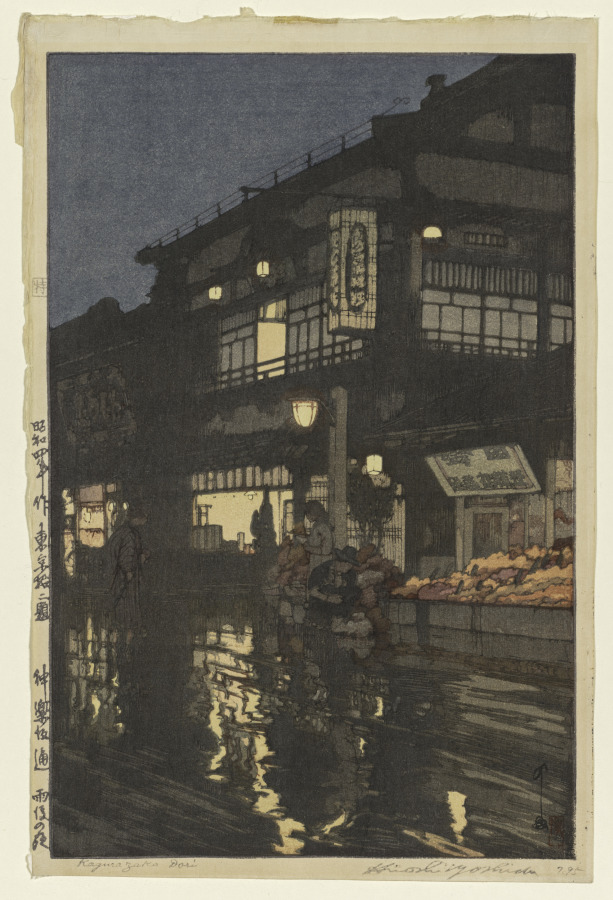
A Little Restaurant at Night (Ryoriya no yoru) is an intimate and atmospheric print depicting a small traditional Japanese restaurant illuminated from within on a quiet evening street. The warm golden light spilling from the restaurant's interior through its open front creates a compelling contrast with the cool blue-gray tones of the surrounding nighttime street. Figures can be glimpsed inside, seated at low tables, while the restaurant's noren curtain and hanging lanterns identify it as a welcoming neighborhood establishment. The wet street surface reflects the warm light, adding luminous depth to the lower portion of the composition.
This print belongs to Yoshida's body of urban night scenes, a genre that allowed him to explore some of the most technically demanding effects in the woodblock medium. Rendering artificial light — its warmth, its glow, and the way it interacts with surrounding darkness — requires a fundamentally different approach from the natural light that characterizes most landscape prints. Yoshida achieved the incandescent quality of the restaurant's illumination through careful layering of warm yellow and amber pigments, with the brightest areas left as minimally printed paper to suggest the intensity of the light source.
The subject reflects Yoshida's interest in the everyday life of Japanese cities during the Taisho and early Showa periods. While many shin-hanga artists focused on idealized traditional subjects — beautiful women, kabuki actors, famous landscapes — Yoshida frequently depicted ordinary scenes that captured the atmosphere of contemporary urban Japan. A small neighborhood restaurant at night carries a specific emotional resonance: warmth, hospitality, and the comfort of familiar places.
The composition's strong contrast between warm interior light and cool exterior darkness creates a psychological as well as visual effect, drawing the viewer toward the illuminated space as a refuge from the surrounding night. This interplay between light and shadow demonstrates Yoshida's sophisticated understanding of chiaroscuro, a Western artistic concept that he integrated seamlessly into the Japanese woodblock tradition.