Biography
Yamamoto Shoun was a Japanese woodblock print artist and painter who lived an extraordinarily long life spanning from 1870 to 1965, making him a witness to nearly a century of Japanese history from the early Meiji era through the postwar economic miracle. Born as Yamamoto Matsunosuke in Kochi Prefecture on the island of Shikoku, he became known for his delicate and charming depictions of beautiful women (bijin-ga) and especially for his beloved prints of children at play, which capture the innocence and joy of childhood in traditional Japan with warmth, humor, and exceptional artistic skill.
Yamamoto's early life in Kochi Prefecture placed him in a region with strong artistic traditions. He showed promise as an artist from a young age and eventually made his way to Tokyo to pursue formal training. He studied Japanese-style painting (nihonga) and developed skills in the traditional techniques that would form the foundation of his printmaking career. His training in nihonga gave him a strong command of brushwork, composition, and the use of color that would distinguish his woodblock print designs throughout his long career.
In Tokyo, Yamamoto established himself as a print designer during the late Meiji period, a time of tremendous cultural change in Japan. The traditional ukiyo-e woodblock print industry was in decline, challenged by new photographic and lithographic printing technologies, but there remained a market for high-quality artistic prints. Yamamoto found his niche creating prints that depicted the everyday life of women and children in a style that bridged the gap between traditional ukiyo-e and the emerging modern sensibilities of the new century. His work from this period shows the influence of late ukiyo-e masters while already displaying the personal touch that would become his signature.
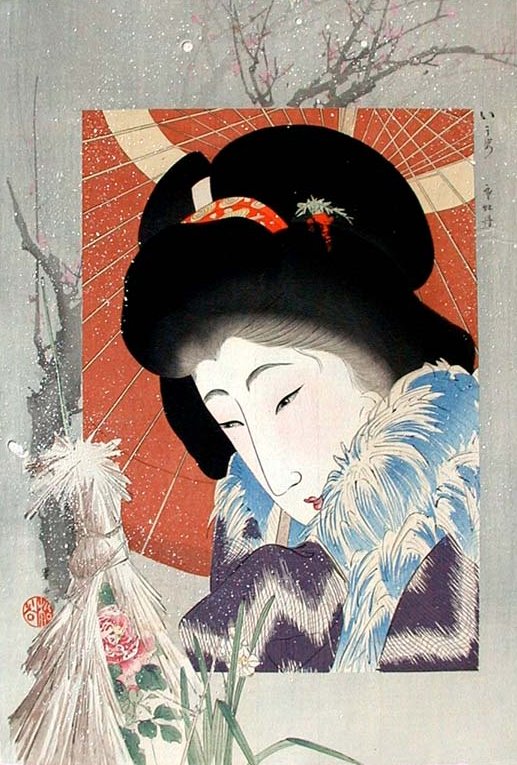
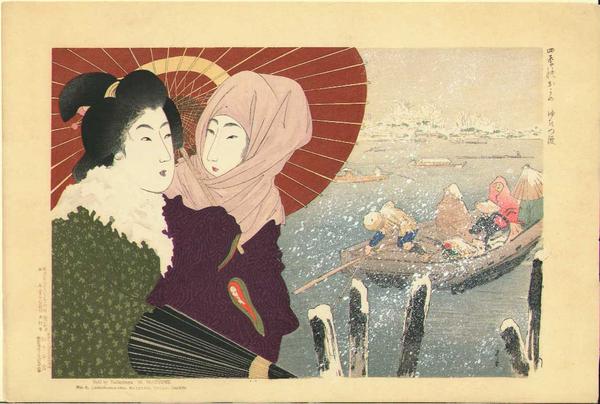
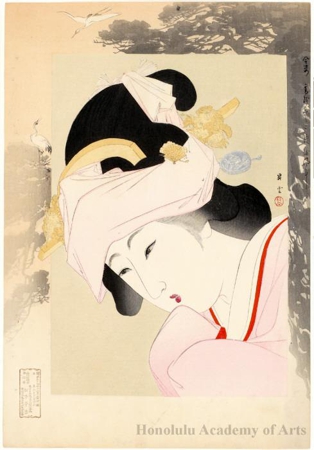
Yamamoto's bijin-ga prints are notable for their gentle, naturalistic approach to depicting women. Unlike the highly stylized and idealized beauties of classical ukiyo-e, his women are rendered with a greater sense of individuality and everyday humanity. They are shown engaged in ordinary activities — reading, sewing, arranging flowers, walking in gardens, or preparing for festivals — rather than posed in artificial settings. This approach aligned with the broader shift in Japanese art toward more realistic and naturalistic depictions that characterized the transition from the Meiji to the Taisho period. His women wear period-appropriate kimono rendered with careful attention to textile patterns and seasonal motifs, making his prints valuable documents of Japanese fashion and material culture.
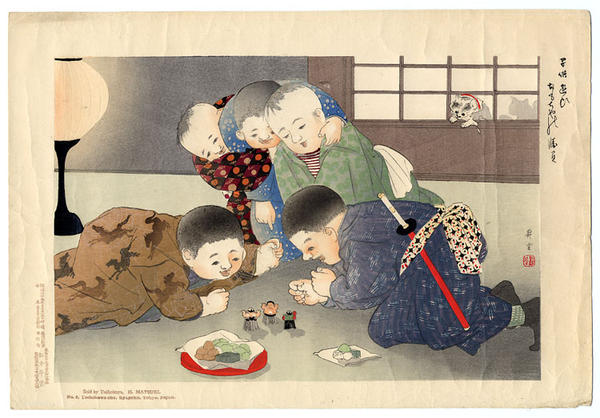
It is perhaps his prints of children, however, that have earned Yamamoto his greatest and most enduring fame. His series depicting children at play are among the most charming and delightful images in the entire tradition of Japanese printmaking. These prints show children engaged in traditional games and seasonal activities — flying kites, playing with tops, catching fireflies, making snowmen, splashing in streams, picking flowers, and celebrating festivals. The children are rendered with a combination of keen observation and gentle humor that captures the energy, curiosity, and emotional expressiveness of childhood. Yamamoto had a rare gift for depicting children as active, lively beings rather than miniature adults, and his prints convey a genuine affection for his young subjects that resonates with viewers across cultures and generations.
The technical quality of Yamamoto's prints is consistently high. He worked with skilled publishers, including Matsuki Heikichi, who employed talented carvers and printers to translate his designs into finished prints. The collaboration between designer and craftsmen was essential to the quality of the final product, and Yamamoto's prints demonstrate the meticulous craftsmanship that characterized the best Japanese printmaking of the late Meiji and Taisho periods. His use of color is particularly noteworthy — he favored a palette of soft, harmonious tones that create a gentle, luminous quality in his prints. Delicate gradations of color (bokashi) are used to create atmospheric effects and to model forms with subtlety and refinement.
Yamamoto's career coincided with major developments in the Japanese print world, including the rise of the shin-hanga movement in the Taisho period. While he was not one of the core artists of the shin-hanga movement in the way that Hashiguchi Goyo or Ito Shinsui were, his work shares many characteristics with shin-hanga, including the emphasis on high production quality, the collaborative model of print production, and the combination of traditional Japanese subject matter with modern artistic sensibilities. His bijin-ga prints in particular connect with the shin-hanga tradition of creating refined, artistically ambitious prints for a discerning audience.
Throughout his long career, Yamamoto also produced paintings and illustrations, but it is his woodblock prints that have secured his place in the history of Japanese art. His prints were popular during his lifetime and have continued to be sought after by collectors. The combination of artistic quality, charming subject matter, and relatively modest print runs has made his works desirable on the international market, with his children-at-play prints being particularly prized.
Yamamoto's extraordinary longevity meant that he lived through some of the most turbulent and transformative periods in Japanese history, including the Russo-Japanese War, the Great Kanto Earthquake, the militarist era of the 1930s, World War II, and the postwar reconstruction. While these events undoubtedly affected his life and career, his artistic output remained focused on the timeless themes of beauty, childhood, and the pleasures of daily life in Japan. His prints offer a vision of Japan that is peaceful, harmonious, and rooted in traditional values, providing a counterpoint to the upheavals and modernization that characterized the nation's history during his lifetime.
The legacy of Yamamoto Shoun rests primarily on the quality and appeal of his prints of children and beautiful women. His children-at-play series, in particular, occupies a unique and cherished place in Japanese printmaking, offering images of childhood that are both culturally specific and universally appealing. These prints continue to be reproduced in books and exhibitions, introducing new generations to the artistry and warmth of Yamamoto's vision. His work is held in numerous museum collections, including the Museum of Fine Arts, Boston, the Honolulu Museum of Art, and various Japanese museums. Yamamoto Shoun stands as an important transitional figure in the history of Japanese printmaking, bridging the late ukiyo-e tradition and the modern movements of the twentieth century with a body of work that is distinguished by its technical excellence, emotional warmth, and enduring charm.
Key Facts
- Active Period
- 1870–1965
- Nationality
- 🇯🇵Japan
- Movement
- Shin-hanga
- Works Indexed
- 20
Frequently Asked Questions
What is Yamamoto Shoun known for?
Yamamoto Shoun was a Japanese woodblock print artist and painter who lived an extraordinarily long life spanning from 1870 to 1965, making him a witness to nearly a century of Japanese history from the early Meiji era through the postwar economic miracle. Born as Yamamoto Matsunosuke in Kochi Prefecture on the island of Shikoku, he became known for his delicate and charming depictions of beautiful women (bijin-ga) and especially for his beloved prints of children at play, which capture the innocence and joy of childhood in traditional Japan with warmth, humor, and exceptional artistic skill.
When was Yamamoto Shoun active?
Yamamoto Shoun was active from 1870 to 1965. They were associated with the Shin-hanga movement.
What artistic movements influenced Yamamoto Shoun?
Yamamoto Shoun's work was shaped by the Shin-hanga tradition in Japanese woodblock printmaking. Shin-hanga: The "new prints" movement (c.
What subjects did Yamamoto Shoun depict?
Yamamoto Shoun's prints frequently feature portraits, landscapes, urban scenes, birds & flowers, snow scenes, rivers & lakes.
How much do Yamamoto Shoun prints cost?
Yamamoto Shoun prints span a fascinating transitional period in Japanese art, bridging the traditional ukiyo-e woodblock printing tradition and the modern shin-hanga movement. His most celebrated works are his series of prints depicting children at play, which combine ukiyo-e compositional traditions with the higher printing standards of the shin-hanga era. Most prints sell for $300–$3,000. Shoun's prints were published by Watanabe Shozaburo and other publishers. For Watanabe-published prints, the edition hierarchy applies: pre-earthquake editions (before September 1923) are the most valuable, as Shoun was one of Watanabe's earliest artists. Pre-earthquake Watanabe editions: $1,500–$3,000+ for his celebrated children series. Post-earthquake recuts: $600–$1,500. Posthumous editions: $300–$800. Look for the small circular Watanabe 6mm seal on pre-earthquake prints. Prints from other publishers have their own edition histories and are generally less collected than the Watanabe publications. His "Children's Play" (Kodomo asobi) series and similar compositions of children in traditional activities are the most sought-after and valuable subjects, appealing to collectors of both Japanese art and historical depictions of childhood. His bijin-ga (beautiful women) prints are also collected but typically sell for less than the children subjects. Pre-earthquake children series: $1,500–$3,000+. Lifetime editions of other subjects: $500–$1,500. Posthumous editions: $300–$800. Shoun's position as a transitional artist between ukiyo-e and shin-hanga gives his work art-historical significance that supports collector interest.
External Resources
Woodblock Prints by Yamamoto Shoun (20)

Children Playing in Summer
夏の子供遊び
c. 1906
Color woodblock print
Children with Lanterns
提灯を持つ子供
c. 1906
Color woodblock print

Children and Carp Streamer
鯉のぼりと子供
c. 1906
Color woodblock print

Children Fishing
魚釣りをする子供
c. 1906
Color woodblock print
Catching Fireflies
蛍狩り
c. 1906
Color woodblock print
Cherry Blossom Viewing
花見
c. 1906
Color woodblock print
Kite Flying
凧揚げ
c. 1906
Color woodblock print
Shuttlecock Game
羽根つき
c. 1906
Color woodblock print
Snow Play
雪遊び
c. 1906
Color woodblock print
Spinning Tops
独楽回し
c. 1906
Color woodblock print
Morning Glories
朝顔
c. 1908
Color woodblock print
Beauty Reading a Letter
手紙を読む美人
c. 1908
Color woodblock print
Beauty Arranging Flowers
生け花をする美人
c. 1908
Color woodblock print
Beauty at Mirror
鏡の前の美人
c. 1908
Color woodblock print
Beauty Playing Shamisen
三味線を弾く美人
c. 1908
Color woodblock print
Beauty in Autumn
秋の美人
c. 1910
Color woodblock print
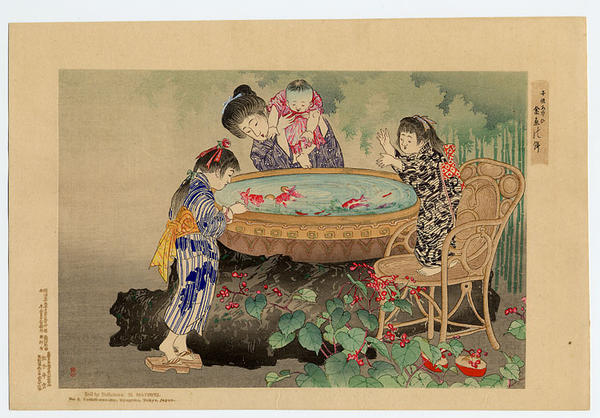
Goldfish Scooping
金魚すくい
c. 1910
Color woodblock print
Beauty in Snow
雪中美人
c. 1910
Color woodblock print
Beauty Under Umbrella
傘を差す美人
c. 1910
Color woodblock print
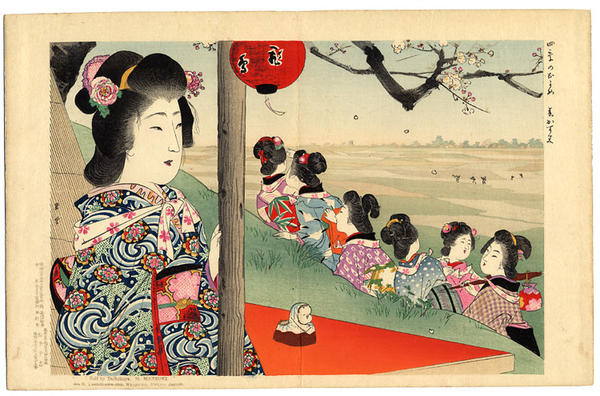
Spring Outing
春の遠足
c. 1910
Color woodblock print