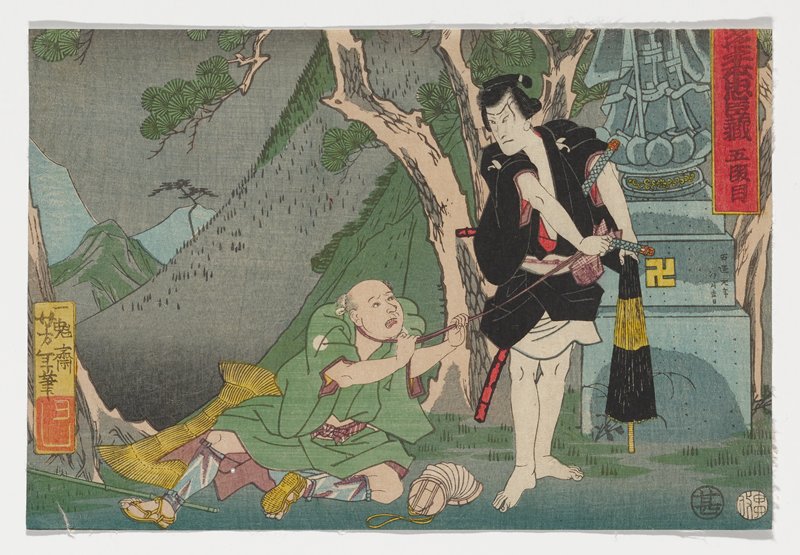
Biography
Tsukioka Yoshitoshi (月岡芳年, 1839–1892) was the last great master of traditional Japanese ukiyo-e woodblock printing, an artist whose dramatic narrative compositions bridged the twilight of the Edo-period print tradition and the dawn of modern Japanese art. Working during one of the most turbulent periods in Japanese history, Yoshitoshi transformed the declining ukiyo-e medium into a vehicle for powerful, psychologically complex imagery that continues to captivate collectors and scholars more than a century after his death.
Born Owariya Yonejiro in Shimbashi, Edo (modern Tokyo), on April 30, 1839, Yoshitoshi entered the studio of the renowned ukiyo-e master Utagawa Kuniyoshi at the age of eleven. Kuniyoshi was famous for his dynamic warrior prints and imaginative compositions, and the young Yoshitoshi absorbed his teacher's bold approach to narrative illustration and love of dramatic subject matter. He adopted the art name Yoshitoshi — combining the "yoshi" from his master's name with "toshi" meaning year — and published his first print at the age of fourteen, a triptych depicting a naval battle from the Genpei wars.
The 1860s were a period of intense creative development for Yoshitoshi, though they also coincided with the violent upheaval of the Bakumatsu era and the Meiji Restoration. The political turmoil and social chaos of this period profoundly shaped his artistic sensibility. During these years he produced the controversial "Twenty-Eight Famous Murders with Verse" (Eimei nijuhasshuku), a series of shockingly graphic depictions of violence and bloodshed that earned him the nickname "Bloody Yoshitoshi." While these prints are often dismissed as sensationalist, they reveal the artist's unflinching engagement with the brutality of his era and his willingness to push the boundaries of the ukiyo-e tradition.
The early Meiji period brought severe hardship to Yoshitoshi and the ukiyo-e world more broadly. Western printing technologies — lithography, photography, and mechanized color printing — threatened to render the traditional woodblock medium obsolete. Many ukiyo-e artists abandoned the craft or descended into poverty. Yoshitoshi himself suffered a mental breakdown in 1872 and spent several years in extreme difficulty, barely able to work. The crisis was both personal and professional, as the art form to which he had devoted his life seemed to be dying around him.
Yoshitoshi's recovery in the late 1870s marked the beginning of his greatest creative period. Rather than imitating Western techniques or retreating into nostalgia, he forged a distinctive new approach that combined the narrative power of traditional ukiyo-e with a modern psychological intensity. His compositions became more sophisticated, his palette more refined, and his treatment of human expression and emotion more nuanced than anything previously achieved in the woodblock medium.
The masterpiece of Yoshitoshi's career is "One Hundred Aspects of the Moon" (Tsuki hyakushi), a series of one hundred prints published between 1885 and 1892. Each print takes the moon as its thematic anchor, depicting scenes drawn from Japanese and Chinese history, mythology, literature, and folklore. The series is remarkable for its range and ambition, encompassing subjects from the mythological — the moon goddess, fox spirits, and ghosts — to the historical — famous samurai, poets, and courtesans — to the intimate — a lonely woman gazing at the moon, a farmer resting after the harvest. The prints are unified by their luminous depictions of moonlight, which Yoshitoshi rendered with extraordinary sensitivity, using subtle gradations of color to evoke the moon's presence even when it is not directly shown.
Another major series from this period is "New Forms of Thirty-Six Ghosts" (Shinkei sanjurokkaisen), published between 1889 and 1892. This series depicts supernatural subjects drawn from Japanese folklore, kabuki theater, and historical legend. The prints combine eerie atmosphere with dramatic narrative power, depicting encounters between humans and the spirit world with a psychological intensity that transcends mere illustration. Works such as "The Ghost of Okiku at Sarayashiki" and "The Fox Woman Kuzunoha" demonstrate Yoshitoshi's ability to evoke genuine terror and pathos through the woodblock medium.
Yoshitoshi also produced notable prints of warriors, beauties, and contemporary subjects. His "Mirror of Beauties Past and Present" (Fūzoku sanjūnisō) presents thirty-two types of women from different historical eras and social classes, each individualized through costume, pose, and expression. His warrior prints, drawing on the tradition of his master Kuniyoshi, depict famous samurai and historical battles with dynamic energy and meticulous attention to armor and weaponry.
Throughout his career, Yoshitoshi worked with several publishers, most notably Akiyama Buemon, who published the "One Hundred Aspects of the Moon" series. The artist was known for his exacting standards and his insistence on high-quality printing, often supervising the carving and printing process closely to ensure that his designs were faithfully reproduced.
Yoshitoshi's mental health remained fragile throughout his later years, and he experienced periodic episodes of depression and instability. Despite these struggles, he maintained a remarkable level of productivity until the very end of his life. He died on June 9, 1892, at the age of fifty-three, leaving behind a body of work comprising over ten thousand designs.
The legacy of Tsukioka Yoshitoshi is that of an artist who refused to let a great tradition die without a final, magnificent flowering. At a time when ukiyo-e was dismissed as a commercial relic, Yoshitoshi demonstrated that the woodblock print could be a medium for serious artistic expression — psychologically complex, technically innovative, and emotionally powerful. His influence extends beyond the print world; manga artists, anime creators, and contemporary Japanese illustrators frequently cite his dramatic compositions and supernatural imagery as foundational inspirations. His works are held in major collections worldwide, including the Los Angeles County Museum of Art, the Museum of Fine Arts Boston, the British Museum, and the Machida City Museum of Graphic Arts in Tokyo.
Key Facts
- Active Period
- 1839–1892
- Nationality
- 🇯🇵Japan
- Movements
- Meiji/Taishō PrintsUkiyo-e
- Works Indexed
- 177
Frequently Asked Questions
What is Tsukioka Yoshitoshi known for?
Tsukioka Yoshitoshi (月岡芳年, 1839–1892) was the last great master of traditional Japanese ukiyo-e woodblock printing, an artist whose dramatic narrative compositions bridged the twilight of the Edo-period print tradition and the dawn of modern Japanese art. Working during one of the most turbulent periods in Japanese history, Yoshitoshi transformed the declining ukiyo-e medium into a vehicle for powerful, psychologically complex imagery that continues to captivate collectors and scholars more than a century after his death.
When was Tsukioka Yoshitoshi active?
Tsukioka Yoshitoshi was active from 1839 to 1892. They were associated with the Meiji/Taishō Prints and Ukiyo-e movements.
What artistic movements influenced Tsukioka Yoshitoshi?
Tsukioka Yoshitoshi's work was shaped by the Meiji/Taishō Prints and Ukiyo-e traditions in Japanese woodblock printmaking. Meiji/Taishō Prints: Meiji and Taishō era prints (1868–1926) bridge the transition from traditional ukiyo-e to the modern shin-hanga and sosaku-hanga movements. Ukiyo-e: Ukiyo-e ("pictures of the floating world") is the dominant tradition of Japanese woodblock printing, flourishing from the seventeenth through nineteenth centuries.
Where can I see Tsukioka Yoshitoshi's original prints?
Original prints by Tsukioka Yoshitoshi can be found in collections including Art Institute of Chicago, Victoria and Albert Museum, Harvard Art Museums.
How much do Tsukioka Yoshitoshi prints cost?
Tsukioka Yoshitoshi is widely regarded as the last great ukiyo-e master, and his prints are among the most actively collected works of late nineteenth-century Japanese art. His masterpiece, 'One Hundred Aspects of the Moon,' is one of the most celebrated print series in Japanese art history, and individual sheets from this series form the core of most Yoshitoshi collections. Prices range from around $500 for minor works to over $50,000 for the finest impressions of his most famous designs. Yoshitoshi's market divides broadly into three categories. His early and mid-career triptychs — battle scenes, historical narratives, and the controversial 'blood prints' — are the most affordable, typically selling for $500-$2,000. The single-sheet designs from his mature period, particularly the 'One Hundred Aspects of the Moon' and 'New Forms of Thirty-Six Ghosts' series, command $2,000-$10,000 for good impressions. The most famous and visually striking designs from these series, in exceptional condition with strong colors and fine impression quality, can achieve $15,000-$50,000 or more at major international auction houses. Condition and impression quality are critical factors in Yoshitoshi pricing. First-edition prints with sharp lines, vibrant colors, and clean paper command significant premiums over later impressions or prints with condition issues such as trimming, staining, or fading. The growing international appreciation for Yoshitoshi's narrative power and psychological intensity has driven steady price appreciation over the past two decades, particularly for his finest mature works.
Woodblock Prints by Tsukioka Yoshitoshi (177)

Chang E Flees to the Moon
1885
Woodblock print (nishiki-e), ink and color on paper

Benkei and the Moon at Daimotsunoura
1886
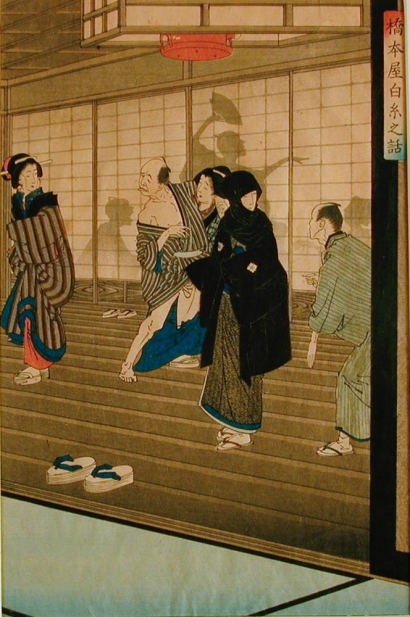
Courtesan Shirato of the Teahouse Hashimoto-ya
1886
Woodblock print

Urashima Taro Returning Home from the Palace of the Dragon King (Urashima Taro no ko kikoku ju Ryugujo no zu)
1886
Color woodblock print; oban diptych

A Cauldron on a Moonlit Night (Tsukiyo no kama), from the series "One Hundred Aspects of the Moon (Tsuki hyakushi)"
1886
Color woodblock print; oban

Yoshitsune and Benkei on the Gojō Bridge
March 1886
Woodblock print (nishiki-e), ink and color on paper

Moon and Smoke (Enchū no tsuki), from the series One Hundred Aspects of the Moon (Tsuki hyaku sugata)
Meiji period, second month of 1886
Woodblock print in "ōban" format; ink and color on paper, with printed signature reading "Yoshitoshi"

Osame, a Concubine of the Lord of Sendai Fief, Learning Courtesanship
1886
Woodblock print

Shunkan Watching Enviously from Kikai Island as Yasuyori Returns to the Capitol after Being Unexpectedly Pardoned (Shunkan sozu Kikaigashima ni oite tamatama Yasuyori no shamen senbo kito no zu)
1886
Color woodblock print; vertical oban diptych
Chōan Killing His Younger Brother at Fuda-no-Tsuji
1886
Woodblock print (nishiki-e) diptych; ink and color on paper

Moonlight over Mount Yoshino
1886

Picture of ‘White Stripe in the Waves’ Zhang Shun and ‘Black Whirlwind’ Li Kui Fighting in the Water
After February 1887
Woodblock print (nishiki-e), ink and color on paper
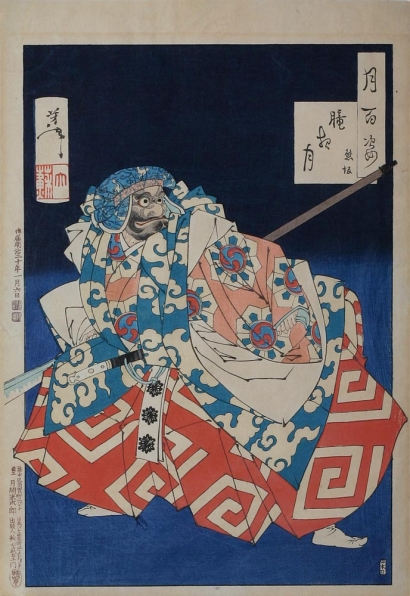
Kumasaka in the Misty Moonlight
1887
Woodblock print

Fukami Jikyu (fukami jikyū)
1887

Fight on the Roof of the Hôryûkaku
1887

The Austerities of Saint Mongaku
1885
Color woodblock print

Lu Zhishen in a Drunken Rage Attacking the Guardian Figure at the Temple on Mount Godai (Rochishin ransui Godaisan Kongojin o uchikowasu no zu)
September 1887
Color woodblock prints; oban diptych

The Two Brave Men Inuzuka Shino and Inugai Genpachi Battling on the Roof of Horyukaku (Horyukaku ryoyu tsutomu)
September 1887
Color woodblock prints; oban diptych

Taira Koremochi Conquering the Devil Woman on Mount Togakushi (Taira no Koremochi Togakushiyama kijo taiji no zu)
1887
Color woodblock prints; oban diptych

Painful (Itaso), from the series "Thirty-two Aspects of Women (Fuzoku sanjuniso)"
1888
Color woodblock print; oban

Slovenly (Shidaranasaso), from the series "Thirty-two Aspects of Women (Fuzoku sanjuniso)"
1888
Color woodblock print; oban
Looking as if She Wants to Go for a Walk: The Fashion of a Married Woman of the Meiji Era (Yūho ga shitasō, Meiji nenkan saikun no fūzoku), from the series Thirty-two Appearances of Fashion (Fūzoku sanjūni sō)
1888
Woodblock print (nishiki-e); ink and color on paper
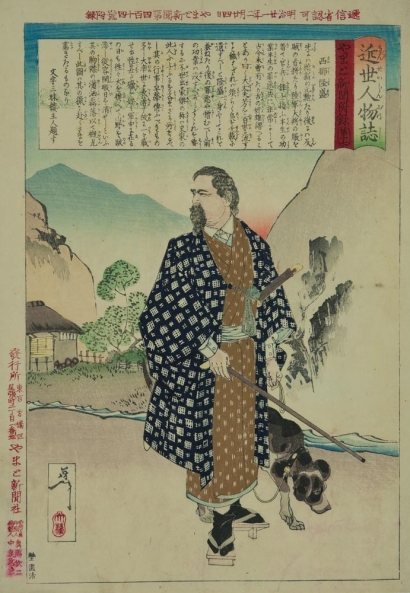
Saigo Takamori with his Dog
1888
Woodblock print
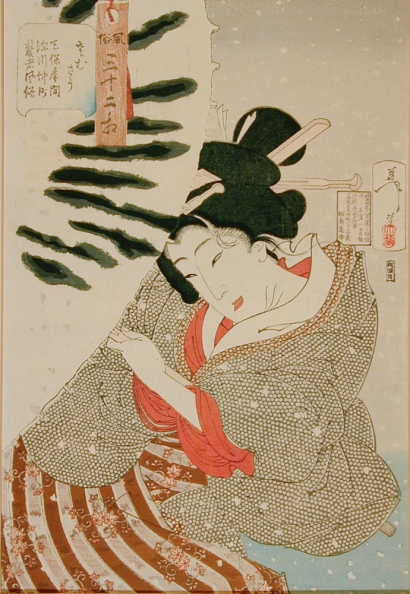
Frozen: The Appearance of a Fukagawa Nakamichi Geisha of the Tempo Era (1830-44)
1888
Woodblock print

In The Mood for a Walk (Yuho ga shitaso), from the series "Thirty-two Aspects of Women (Fuzoku sanjuniso)"
1888
Color woodblock print; oban
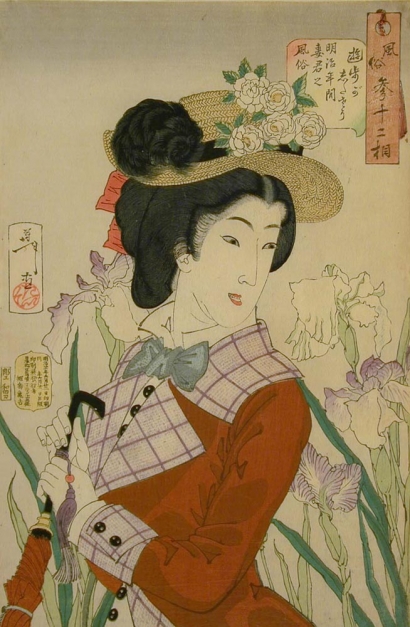
Preparing to Take a Stroll: A Married Woman in the Meiji Period
1888
Woodblock print

Appearing Warm, Behavior of an Urban Widow of the Kansei Era
March 1888
Woodblock print (nishiki-e), ink and color on paper

Table of Contents
October 1888
Woodblock print (nishiki-e), ink and color on paper
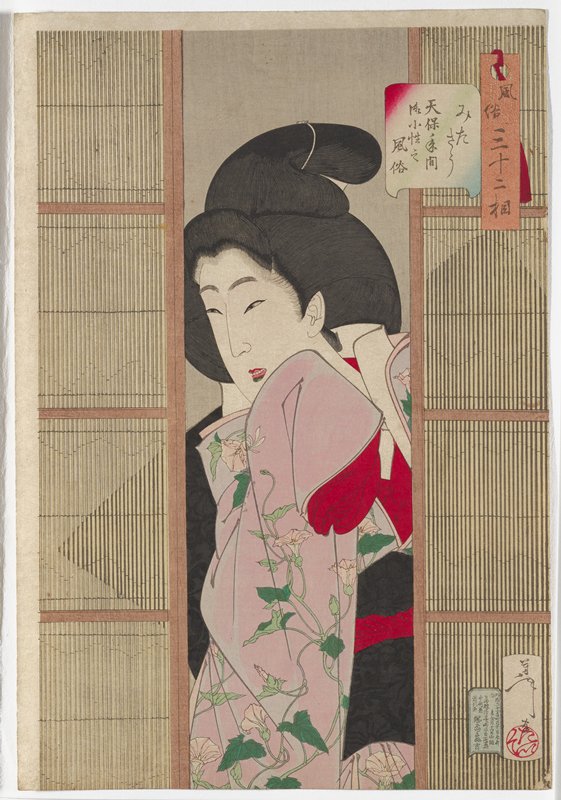
Appearing Inquisitive, Behavior of a Maid of the Tenpō Era
April 1888
Woodblock print (nishiki-e), ink and color on paper

Delighted (Ureshiso), from the series "Thirty-two Aspects of Women (Fuzoku sanjuniso)"
1888
Color woodblock print; oban
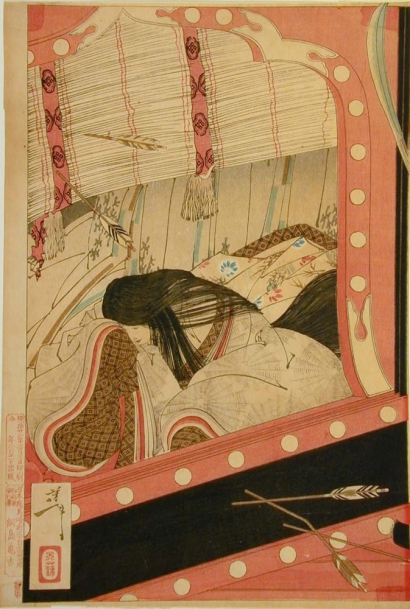
Untitled (Part of a Triptych: A Woman being Shot by Arrows)
1889
Woodblock print
Demon in Disguise as an Old Woman Fleeing with a Severed Arm (Rōba kiwan o mochisaru zu), from the series New Forms of Thirty-Six Ghosts (Shinkei sanjūroku kaisen)
1889
Woodblock print (nishiki-e); ink, color and gauffrage on paper

The Old Badger from the series "New Forms of Thirty-Six Ghosts"
1889
Color woodblock print

Oniwakamaru Observing the Great Carp in the Pond, from the series "New Forms of Thirty-Six Ghosts"
1889
Color woodblock print

Omori Hikoshichi from the series “New Forms of the Thirty-Six Ghosts”
1889
Color woodblock print

Heron Maiden from the series "New Forms of Thirty-Six Ghosts"
1889
Color woodblock print

Monsters jumping out of a box scaring a man, draft for the print 'The Heavy Basket' (Omoi tsuzura)
around 1889
Preparatory drawing for a print, ink and color on paper

Picture of Shōki Capturing a Demon in the Dream
1890
Woodblock print (nishiki-e), ink and color on paper
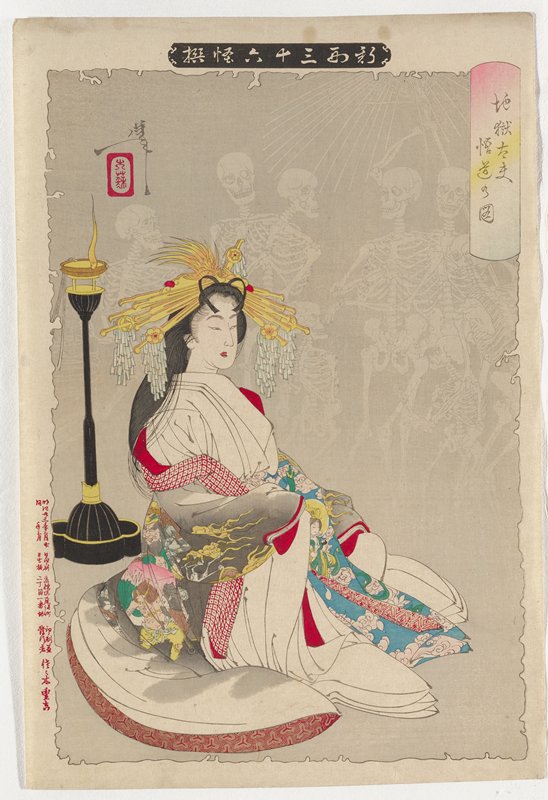
Picture of the Hell Courtesan’s Enlightenment
February 1890
Woodblock print (nishiki-e), ink and color on paper

Onoe Kikugorō V as the Hag of Asajigahara
1890
Color woodblock prints; ōban triptych

Ichikawa Danjūrō IX as Kezori Kuemon
About 1890
Color woodblock prints; ōban triptych

Ichikawa Danjūrō IX as Musashibō Benkei in The Subscription List (Kanjinchō)
Meiji period, datable to 1890
Center panel from a woodblock print (nishiki-e) triptych; ink, color, gauffrage, and metallic pigment on paper

The Actor Onoe Kikugoro V as the Priest Sogen (Yuki: Iwakura Sogen Onoe Baiko), from the series "Snow, Moon, and Flowers (Setsugekka no uchi)"
1890
Color woodblock prints; oban triptych

Moon of Kintoki's Mountain
October 1890
Woodblock print (nishiki-e), ink and color on paper

Gamo Sadahide's Servant, Toki Motosada, Hurling a Demon King to the Ground at Mount Inahana, from the series "New Forms of Thirty-Six Ghosts (Shinkei sanjuroku kaisen)"
1890
Color woodblock print
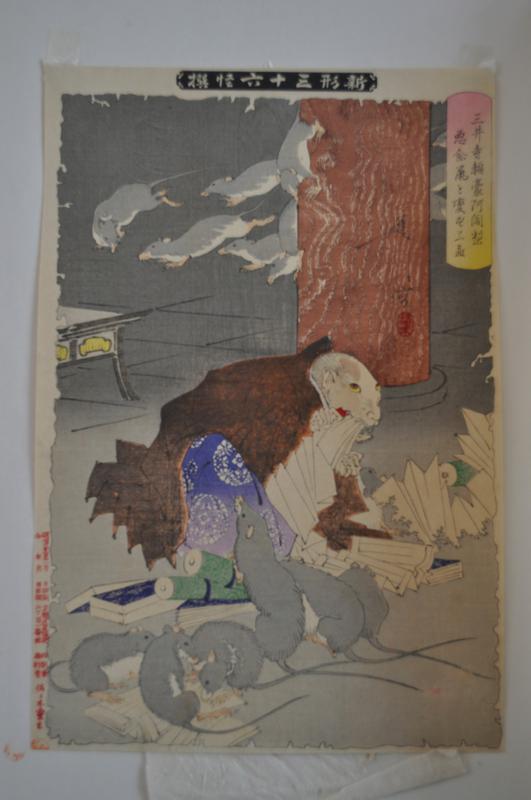
Priest Raigo of Miidera Transforming into a Vengeful Rat
1891
Woodblock print (nishiki-e), ink and color on paper

Kiku moyō enmei bukuro, no. 2
July 1891
Woodblock print (nishiki-e), ink and color on paper
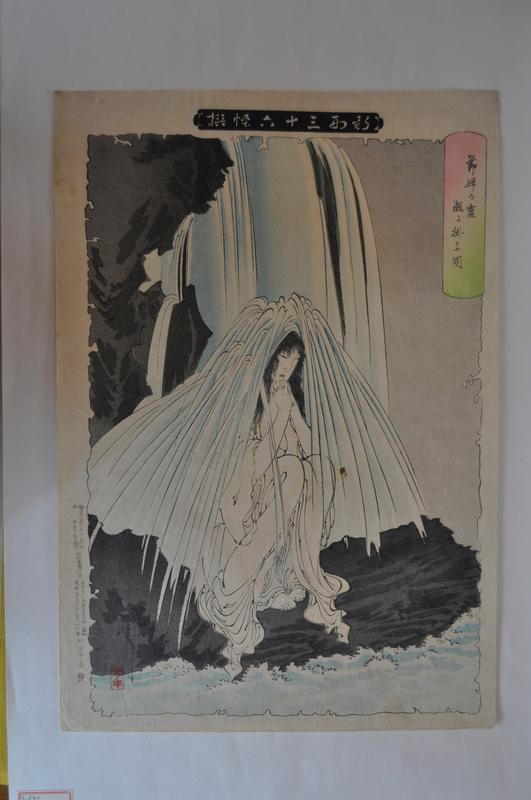
Spirit of a Faithful Wife in a Waterfall
1892
Woodblock print (nishiki-e), ink and color on paper
Moon at Musashi Plain (Musashino no tsuki), from the series One Hundred Aspects of the Moon (Tsuki hyaku sugata)
Meiji period, 1892 (4th month)
Ukiyo-e woodblock print in "ōban" format; ink and color on paper, with printed signature reading "Yoshitoshi"
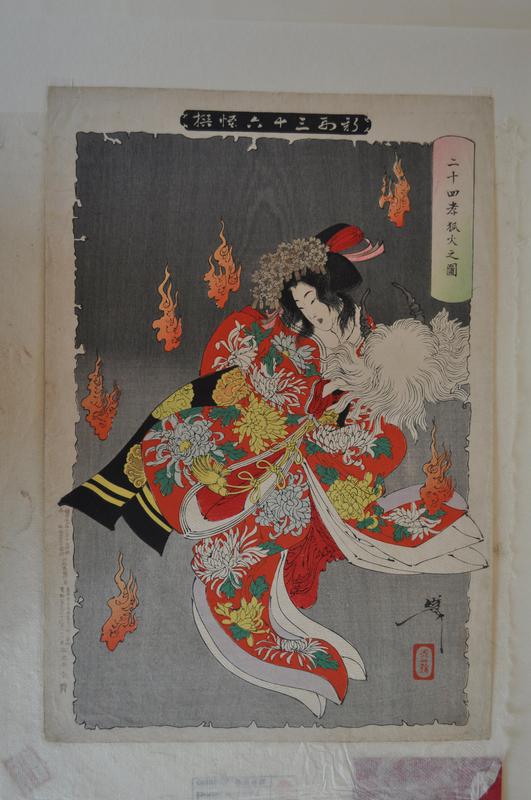
Fox-fire of the Twenty-four Paragons of Filial Piety
1892 (this edition Feb. 1902)
Woodblock print (nishiki-e), ink and color on paper

Study of a leaping carp
19th century
Preparatory drawing for a print, ink on paper

'The fox woman of Suwa in Shinano'
19th century

'Jigoku Daiyu, the Hell Courtesan, meditating'
19th century
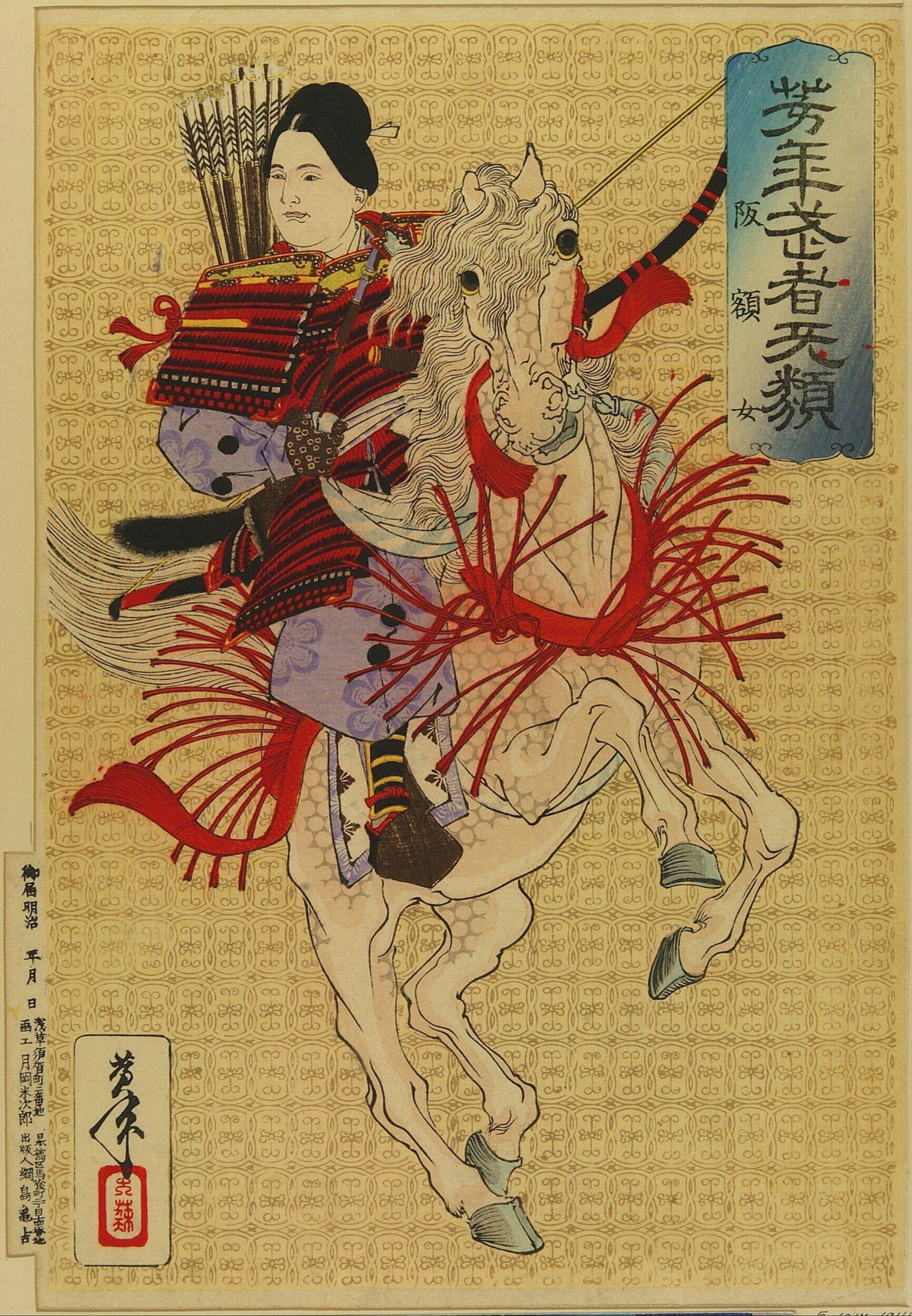
'The female samurai warrior Hangaku'

The Ghost of Genji's lover
19th century
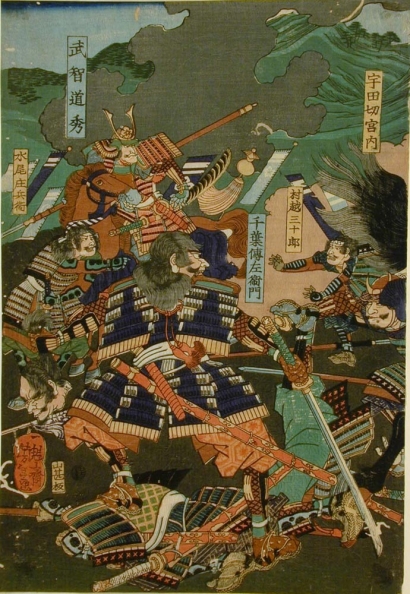
Denzaemon Chiba with severed head
description
Woodblock print
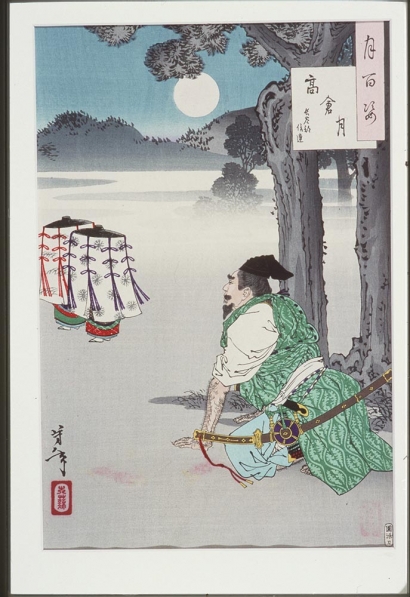
The Moon at Takakura
description
Woodblock print