
Biography
Utagawa Kuniyoshi (歌川国芳, 1798–1861) stands as one of the most inventive and technically accomplished artists of the ukiyo-e tradition, a figure whose restless imagination pushed the boundaries of Japanese woodblock printing in directions that continue to surprise viewers today. Known variously by his art name Ichiyusai, he was a master of warrior prints, a pioneer of landscape composition, a satirist of uncommon wit, and perhaps history's most devoted artistic chronicler of cats.
Kuniyoshi was born on January 1, 1798, in the Nihonbashi district of Edo (present-day Tokyo), the son of Yanagiya Kichiemon, a silk dyer. His father's trade exposed him from childhood to the bold patterns and vivid colors that would later characterize his prints. At approximately age twelve, around 1811, he entered the studio of Utagawa Toyokuni I, the leading master of the Utagawa school and the most commercially successful ukiyo-e artist of his generation. This placed Kuniyoshi among a cohort of students that included Utagawa Kunisada, who would become his lifelong professional rival.
The early years of Kuniyoshi's independent career were marked by prolonged struggle. After receiving his art name and beginning to publish around 1814, he found little commercial success. The market was dominated by Kunisada's actor portraits and Keisai Eisen's bijin-ga, and Kuniyoshi's early efforts in these genres failed to distinguish themselves. By some accounts he was so poor during this period that he supplemented his income by selling tatami mats and repairing broken goods.
The breakthrough arrived in 1827, when Kuniyoshi began publishing his series "108 Heroes of the Popular Suikoden," depicting the legendary Chinese bandits of the classical novel "Water Margin." These prints were a revelation. Each hero was rendered as a figure of explosive dynamism — muscles rippling beneath elaborate full-body tattoos, weapons raised against swirling backgrounds of water, flame, and storm. The series tapped into a contemporary craze for tattooing among Edo's townspeople, and the prints themselves became reference designs for tattoo artists, a role they continue to serve nearly two centuries later. The Suikoden series made Kuniyoshi famous overnight and established the warrior print (musha-e) as his signature genre.
Through the 1830s and 1840s, Kuniyoshi produced an extraordinary body of warrior prints that remain unsurpassed in their dramatic power and compositional daring. His depictions of samurai battles, mythological combats, and scenes from Japanese history combined meticulous period detail with a sense of kinetic energy entirely new to the medium. He was particularly innovative in his use of the triptych format, composing scenes across three joined sheets to create panoramic images of remarkable sweep and complexity.
Kuniyoshi was also a significant landscape artist. His landscape prints reveal a sophisticated engagement with Western art, which he studied through Dutch engravings that entered Japan via Nagasaki. He incorporated Western single-point perspective, chiaroscuro shading, and atmospheric effects into his compositions, sometimes producing landscapes that hover in a striking intermediate space between European and Japanese pictorial conventions.
Among Kuniyoshi's most enduring works are his humorous prints (giga). He was famously devoted to cats — contemporary accounts describe his studio as perpetually overrun with them — and he produced numerous prints featuring cats in anthropomorphic roles: cats forming the shapes of human faces, cats mimicking kabuki actors, cats dressed as people going about daily business. Beyond their charm, these works served a serious purpose in an era of increasing government censorship. The Tempo Reforms of the 1840s banned prints depicting actors, courtesans, and other subjects deemed to promote luxury. Kuniyoshi responded with characteristic ingenuity, producing prints that appeared to depict animals but contained veiled political commentary legible to his Edo audience.
Kuniyoshi's studio trained an estimated seventy or more students. Among his most distinguished pupils were Tsukioka Yoshitoshi, widely regarded as the last great master of ukiyo-e, whose powerful prints carried his teacher's dramatic sensibility into the Meiji era; Utagawa Yoshitora, who became an important chronicler of Yokohama; and Utagawa Yoshiiku, a pioneer of newspaper illustration.
Kuniyoshi suffered a stroke around 1855 that partially paralyzed him. He died on April 14, 1861, in Edo, just seven years before the Meiji Restoration would sweep away the feudal order that had shaped the world of ukiyo-e. His legacy resides not merely in the enormous volume of his output — estimated at over ten thousand designs — but in the range and daring of his artistic vision. His warrior prints defined the visual iconography of the samurai for subsequent generations. His humorous works anticipated modern cartooning and graphic design. Among the last great masters of ukiyo-e, Kuniyoshi was also the most forward-looking, an artist whose work speaks across centuries with undiminished vitality.
Key Facts
- Active Period
- 1798–1861
- Movement
- Ukiyo-e
- Works Indexed
- 199
Frequently Asked Questions
What is Utagawa Kuniyoshi known for?
Utagawa Kuniyoshi (歌川国芳, 1798–1861) stands as one of the most inventive and technically accomplished artists of the ukiyo-e tradition, a figure whose restless imagination pushed the boundaries of Japanese woodblock printing in directions that continue to surprise viewers today. Known variously by his art name Ichiyusai, he was a master of warrior prints, a pioneer of landscape composition, a satirist of uncommon wit, and perhaps history's most devoted artistic chronicler of cats.
When was Utagawa Kuniyoshi active?
Utagawa Kuniyoshi was active from 1798 to 1861. They were associated with the Ukiyo-e movement.
What artistic movements influenced Utagawa Kuniyoshi?
Utagawa Kuniyoshi's work was shaped by the Ukiyo-e tradition in Japanese woodblock printmaking. Ukiyo-e: Ukiyo-e ("pictures of the floating world") is the dominant tradition of Japanese woodblock printing, flourishing from the seventeenth through nineteenth centuries.
Where can I see Utagawa Kuniyoshi's original prints?
Original prints by Utagawa Kuniyoshi can be found in collections including Art Institute of Chicago, Harvard Art Museums, Victoria and Albert Museum.
External Resources
Woodblock Prints by Utagawa Kuniyoshi (199)
Kohada Koheiji Konoshiro Tomobei kataki uchi maboroshi sōshi (Ghost Story of Konoshiro Tomobei), draft and printed edition
Edo period, 1812 and 1845
Pair of books: draft and printed edition; ink and light color on paper

Roben Waterfall at Mount Oyama (Oyama Roben no taki)
c. 1818/20
Color woodblock prints; oban triptych
Warrior Watari Shinzaemon (?) Grappling with a Guardian Statue
Edo period, circa 1820s
Ukiyo-e woodblock print in "ōban" format; ink and color on paper

Octopus and Shell
about 1820s
Color woodblock print; shikishiban, surimono
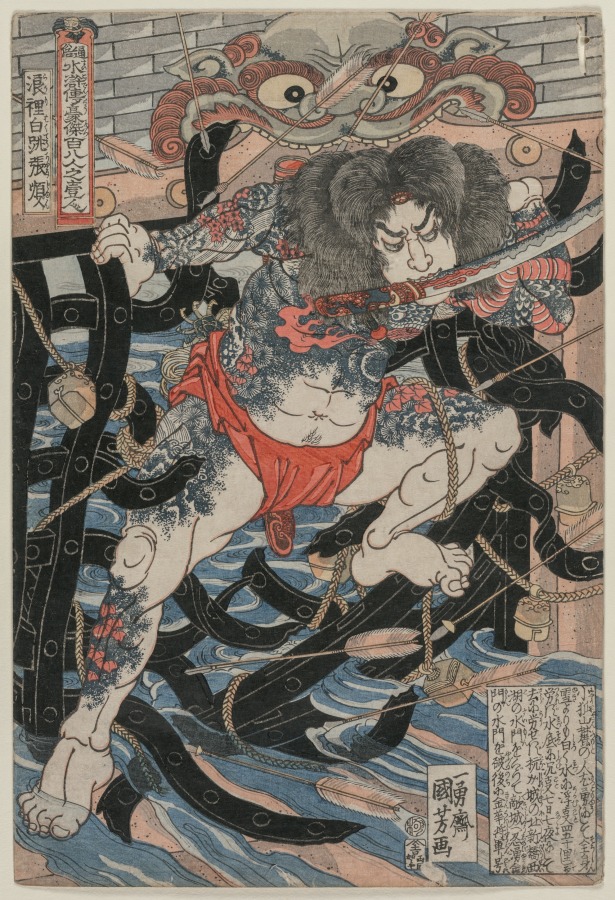
Rori Hakucho Chojun (from the series 108 Heroes of the Novel Shui Hu Chuan)
late 1820s
color woodblock print

Chen Da (Chokanko Chintatsu), from the series "One Hundred and Eight Heroes of the Popular Water Margin (Tsuzoku Suikoden goketsu hyakuhachinin no hitori)"
c. 1827/30
Color woodblock print; left sheet of oban triptych

Yan Qing (Roshi Ensei), from the series "One Hundred and Eight Heroes of the Popular Water Margin (Tsuzoku Suikoden goketsu hyakuhachinin no hitori)"
c. 1827/30
Color woodblock print; oban

Zhang Qing (Botu'usen Chosei), from the series "One Hundred and Eight Heroes of the Popular Water Margin (Tsuzoku Suikoden goketsu hyakuhachinin no hitori)"
c. 1827/30
Color woodblock print; oban

Lu Junyi (Gyokukirin Roshungi), from the series "One Hundred and Eight Heroes of the Popular Water Margin (Tsuzoku Suikoden goketsu hyakuhachinin no hitori)"
c. 1827/30
Color woodblock print; oban
![Wu Song (Seikaken no san Busho), from the series "One Hundred and Eight Heroes of the [Popular] Water Margin ([Tsuzoku] Suikoden goketsu hyakuhachinin no hitori)" by Utagawa Kuniyoshi](https://www.artic.edu/iiif/2/517bdaa5-8b45-dbd1-030d-e6896bc46b65/full/843,/0/default.jpg)
Wu Song (Seikaken no san Busho), from the series "One Hundred and Eight Heroes of the [Popular] Water Margin ([Tsuzoku] Suikoden goketsu hyakuhachinin no hitori)"
c. 1827/30
Color woodblock print; oban

Wu Yong (Chitasei Goyo), from the series "One Hundred and Eight Heroes of the Popular Water Margin (Tsuzoku Suikoden goketsu hyakuhachinin no hitori)"
c. 1827/30
Color woodblock print; oban

Ma Lin (Tettekisen Barin), from the series "One Hundred and Eight Heroes of the Popular Water Margin (Tsuzoku Suikoden goketsu hyakuhachinin no hitori)"
c. 1827/30
Color woodblock print; oban

Dawn over Mout Fuji and Susaki, from the series "Five Views of Mount Fuji (Fuji goban no uchi)"
c. 1827/29
Color woodblock print; shikishiban surimono

Cao Zheng (Sotoki Sosei), from the series "One Hundred and Eight Heroes of the Popular Water Margin (Tsuzoku Suikoden goketsu hyakuhachinin no hitori)"
c. 1827/30
Color woodblock print; oban, keyblock proof impression with light color

Zheng Tianshou (Hakumenrokun Teitenja), from the series "One Hundred and Eight Heroes of the Popular Water Margin (Tsuzoku Suikoden goketsu hyakuhachinin no hitori)"
c. 1827/30
Color woodblock print; oban

Lu Zhishen, Originally Named Lu Da (Kaosho Rochishin shomei Rotatsu), from the series "One Hundred and Eight Heroes of the Popular Water Margin (Tsuzoku Suikoden goketsu hyakuhachinin no hitori)"
c. 1827
Color woodblock print; oban

Sun Li (Byo'utchi Sonritsu), from the series "One Hundred and Eight Heroes of the Popular Water Margin (Tsuzoku Suikoden goketsu hyakuhachinin no hitori)"
c. 1827/30
Color woodblock print; oban

Yang Lin (Kinhyoshi Yorin), from the series "One Hundred and Eight Heroes of the Popular Water Margin (Tsuzoku Suikoden goketsu hyakuhachinin no hitori)"
c. 1827/30
Color woodblock print; oban

Ruan Xiao'er (Ritchitaisai Genshoji), from the series "One Hundred and Eight Heroes of the Popular Water Margin (Tsuzoku Suikoden goketsu hyakuhachinin no hitori)"
c. 1827/30
Color woodblock print; oban

Li Kui (Kokusenpu Riki, ichimei Ritetsugyu), from the series "One Hundred and Eight Heroes of the Popular Water Margin (Tsuzoku Suikoden goketsu hyakuhachinin no hitori)"
c. 1827
Color woodblock print; oban

Rua Xiaoqi (Katsuenra Genshoshichi), from the series "One Hundred and Eight Heroes of the Popular Water Margin (Tsuzoku Suikoden goketsu hyakuhachinin no hitori)"
c. 1827/30
Color woodblock print; oban

Xie Zhen (Ryotoda Kaichin), from the series "One Hundred and Eight Heroes of the Popular Water Margin (Tsuzoku Suikoden goketsu hyakuhachinin no hitori)"
c. 1827/30
Color woodblock print; oban

Hu Sanniang (Ko Sanjo Ichijosei), from the series "One Hundred and Eight Heroes of the Popular Water Margin (Tsuzoku Suikoden goketsu hyakuhachinin no hitori)"
c. 1827/30
Color woodblock print; oban

Yang Zhi (Seimenju Yoshi), from the series "One Hundred and Eight Heroes of the Popular Water Margin (Tsuzoku Suikoden goketsu hyakuhachinin no hitori)"
c. 1827/30
Color woodblock print; oban

Bai Sheng (Hakujisso Hakusho), from the series "One Hundred and Eight Heroes of the Popular Water Margin (Tsuzoku Suikoden goketsu hyakuhachinin no hitori)"
c. 1827/30
Color woodblock print; oban

Low Tide at Susaki - A Set of Five (Shiohi goban no uchi)
c. 1828-30
Color woodblock prints; shikishiban pentaptych, surimono
![Gen Shogo [Ruan Xiaowu]; Five-sheet print of Collecting Brine, no. 5 by Utagawa Kuniyoshi](https://1.api.artsmia.org/800/82218.jpg)
Gen Shogo [Ruan Xiaowu]; Five-sheet print of Collecting Brine, no. 5
c. 1828–30
Woodblock print (surimono), ink and color on paper

Distant View of Mount Fuji at Dawn from Hakone
c. 1828/30
Color woodblock print; shikishiban, surimono

Ensei
c. 1828–30
Woodblock print (surimono), ink and color on paper

Oteiroku, from the series "Fashionable Women as the One Hundred and Eight Heroes of the Water Margin (Fuzoku onna Suikoden, ippyakuhachinin no uchi)"
c. 1828/30
Color woodblock print; surimono

Washing Hands as a Mitare of Gongsun Sheng
c. 1828
Woodblock print (surimono), ink and color on paper
Ro Shungi (Chinese: Lu Junyi), from the series Elegant Women's The Water Margin: From One Hundred and Eight Figures (Fuzoku onna Suikoden: Ippyaku-hachinin no uchi)
c. 1828-1832
Woodblock print (surimono); ink, color, and metallic pigments on paper

Saishin, from the series "Fashionable Women as the One Hundred and Eight Heroes of the Water Margin (Fuzoku onna Suikoden, ippyakuhachinin no uchi)"
c. 1828/30
Color woodblock print; surimono
Genshōshichi, from the series Elegant Women's The Water Margin: From One Hundred and Eight Figures (Fuzoku onna Suikoden: Ippyaku-hachinin no uchi)
c. 1828-1832
Woodblock print (surimono); ink, color, and metallic pigments on paper

Snow: Onoe Kikugoro III, from "A Set of Three (Sanbantsuzuki)"
c. 1829
Color woodblock print; shikishiban surimono

Ōmori, from the series Famous Places in the Eastern Capital
early 1830s
Color woodblock print

View of Mitsumata in the Eastern Capital (Toto Mitsumata no zu), from the series "Views of the Eastern Capital (Toto no zu)"
early 1830s
Color woodblock print; oban
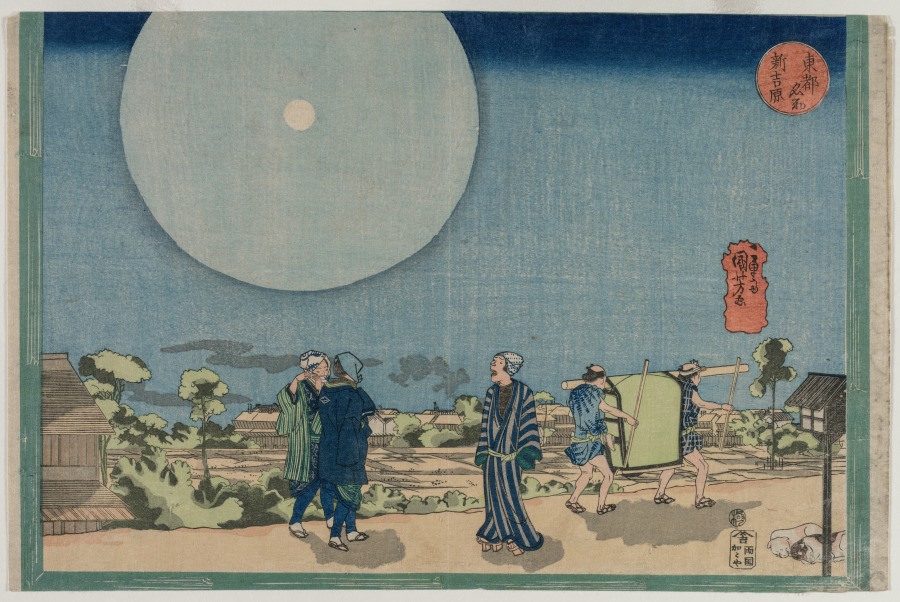
New Yoshiwara (Shin Yoshiwara), from the series Famous Places in the Eastern Capital
early 1830s
color woodblock print
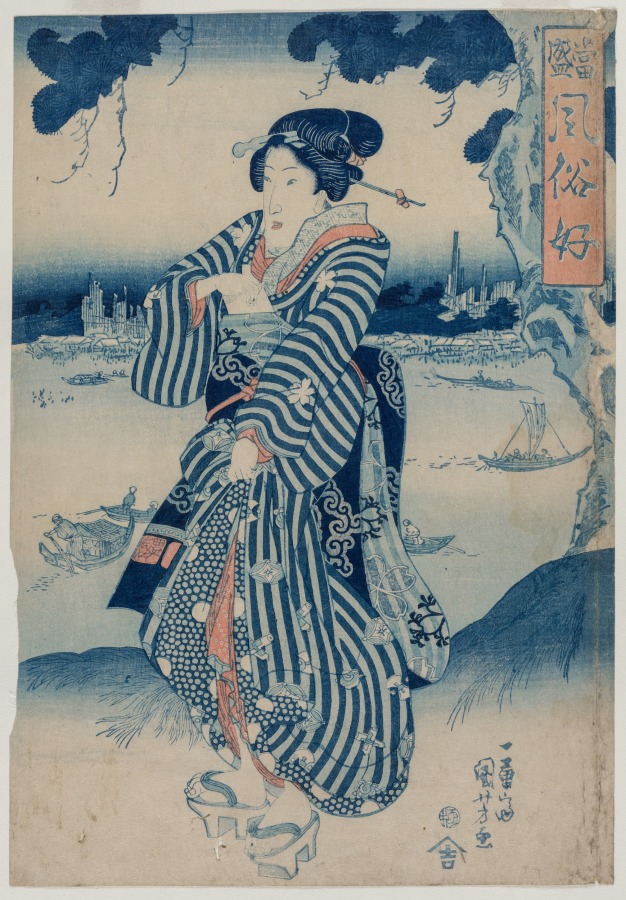
Geisha Standing on the Bank of the Sumida River (from the series People Who Like the Latest Fashions and Manners)
early 1830s
color woodblock print

The Night Attack, Act XI
ca. 1830

Nichiren in the Snow at Tsukahara on Sado Island (Sashū Tsukahara setchū), from the series Sketches of the Life of the Great Priest (Kōsō goichidai ryakuzu)
Edo period, circa 1830-1835 (Tenpō 1-6)
Ukiyo-e woodblock print in "ōban" format; ink and color on paper, with printed signature reading "Ichiyūsai Kuniyoshi hitsu"
![The Star Descends on Echi on the Thirteenth Night of the Ninth Month (Kugatsu jusan yoru Echi shoko), from the series "Concise Illustrated Biography of the Great Priest [Nichiren] (Koso go ichidai ryakuzu)" by Utagawa Kuniyoshi](https://www.artic.edu/iiif/2/b8952a32-3c4e-c7f7-129e-772f2eb64254/full/843,/0/default.jpg)
The Star Descends on Echi on the Thirteenth Night of the Ninth Month (Kugatsu jusan yoru Echi shoko), from the series "Concise Illustrated Biography of the Great Priest [Nichiren] (Koso go ichidai ryakuzu)"
c. 1830/35
Color woodblock print; oban

Night scence aboard a pleasure boat
c. 1830's
Color woodblock print; shikishiban diptych, surimono
Four Stations: Okabe, Fujieda, Shimada and Kanaya, from the series Famous Views of the Fifty-three Stations of the Tōkaidō Road (Tōkaidō gojūsan eki yonshuku meisho)
Edo period, circa 1830-1835 (Tenpō 1-6)
Ukiyo-e woodblock print in "ōban" format; ink and color on paper, with printed signature reading "Ichiyūsai Kuniyoshi ga"
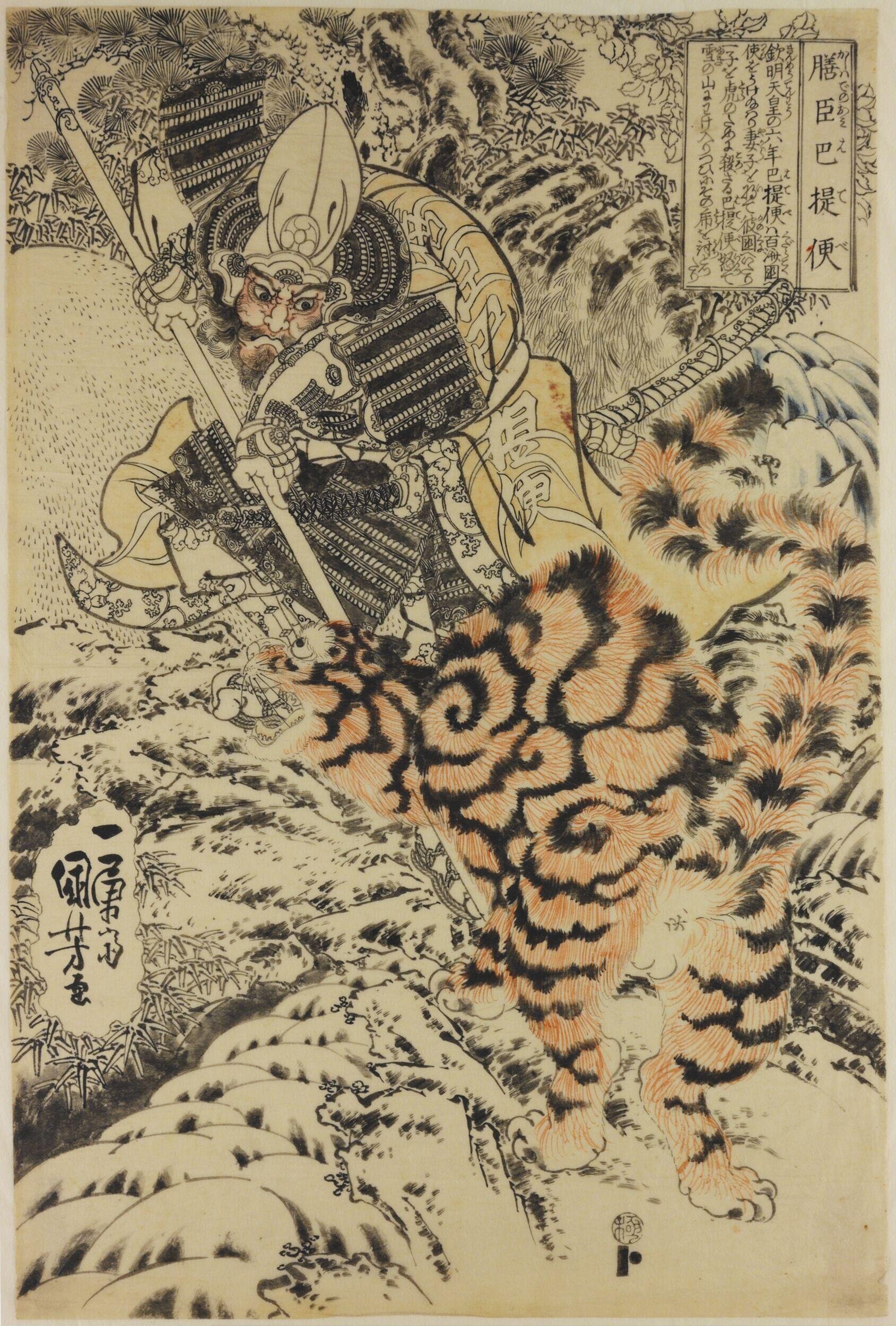
Kashiwade no Hatebe
mid 1830s

Flowers: Onoe Kikugoro III, from an untitled series of actors representing snow, moon, and flowers
c. 1830s
Color woodblock print; shikishiban, surimono

Minakuchi, Ishibe, Kusatsu, Otsu, and Kyoto, from the series "Famous Places on the Fifty-three Stations of the Tokaido, Five Stations (Tokaido gojusan eki goshuku meisho)"
c. 1830/35
Color woodblock print; oban

Miya, Kuwana, Yokkaichi, and Ishiyakushi, from the series "Famous Places on the Fifty-three Stations of the Tokaido, Four Stations (Tokaido gojusan eki yonshuku meisho)"
c. 1830/35
Color woodblock print; oban

Women holding fan in her mouth
c. early 1830s
Color woodblock print; right sheet of shikishiban triptych, surimono
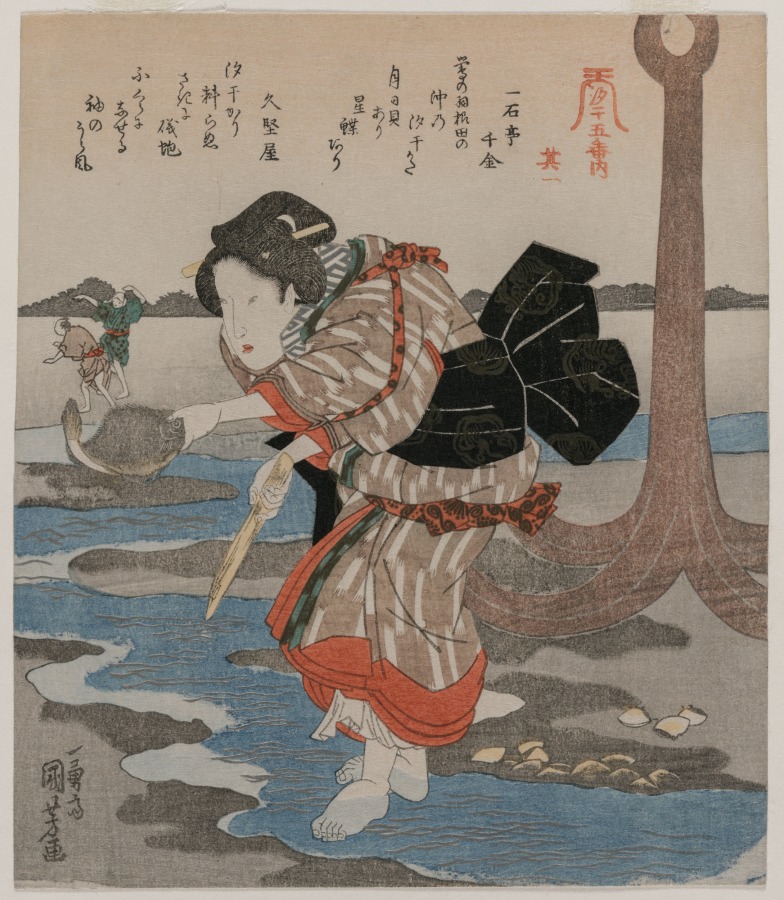
A Low Tide Pentaptych
c. 1830
Pentaptych of color woodblock prints

The actor Sawamura Tossho as Yoemon
c. 1830s
Color woodblock print; oban
![Praying for Rain at Ryozengasaki in Kamakura, 1271 (Bun'ei hachi Kamakura Ryozengasaki ame inoru), from the series "Concise Illustrated Biography of the Great Priest [Nichiren] (Koso go ichidai ryakuzu)" by Utagawa Kuniyoshi](https://www.artic.edu/iiif/2/4a497108-12ad-0923-2dba-6e9acef02ee5/full/843,/0/default.jpg)
Praying for Rain at Ryozengasaki in Kamakura, 1271 (Bun'ei hachi Kamakura Ryozengasaki ame inoru), from the series "Concise Illustrated Biography of the Great Priest [Nichiren] (Koso go ichidai ryakuzu)"
c. 1830/35
Color woodblock print; oban

Nihonbashi, Shinagawa, Kawasaki, and Kanagawa, from the series "Famous Places on the Fifty-three Stations of the Tokaido, Four Stations (Tokaido gojusan eki yonshuku meisho)"
c. 1830/35
Color woodblock print; oban

Shono, Kameyama, Seki, Sakanoshita, and Tsuchiyama, from the series "Famous Places on the Fifty-three Stations of the Tokaido, Five Stations (Tokaido gojusan eki goshuku meisho)"
c. 1830/35
Color woodblock print; oban

Man Crossing a Bridge as the Sun Rises, from an untitled edition (without poetry) of the illustrations for the series "Five Prints of Mount Fuji (Fuji goban no uchi)"
c. 1830
Color woodblock print; shikishiban, surimono

Nissaka, Kakegawa, Fukuroi, Mitsuke, and Hamamatsu, from the series "Famous Places on the Fifty-three Stations of the Tokaido, Five Stations (Tokaido gojusan eki goshuku meisho)"
c. 1830/35
Color woodblock print; oban
![Casting a Mantra on the Waves at Kakuta on His Exile to Sado Island (Sashu rukei Kakuta nami daimoku), from the series "Concise Illustrated Biography of the Great Priest [Nichiren] (Koso go ichidai ryakuzu)" by Utagawa Kuniyoshi](https://www.artic.edu/iiif/2/7861e903-25d0-c779-7382-7055de763691/full/843,/0/default.jpg)
Casting a Mantra on the Waves at Kakuta on His Exile to Sado Island (Sashu rukei Kakuta nami daimoku), from the series "Concise Illustrated Biography of the Great Priest [Nichiren] (Koso go ichidai ryakuzu)"
c. 1830/35
Color woodblock print; oban
Kasumigaseki
c. 1830–35
Woodblock print (nishiki-e), ink and color on paper

Akasaka, Fujikawa, Okazaki, Chiryu, and Narumi, from the series "Famous Places on the Fifty-three Stations of the Tokaido, Five Stations (Tokaido gojusan eki goshuku meisho)"
c. 1830/35
Color woodblock print; oban

Hara, Yoshiwara, and Kanbara, from the series "Famous Places on the Fifty-three Stations of the Tokaido, Three Stations (Tokaido gojusan eki sanshuku meisho)"
c. 1830/35
Color woodblock print; oban