Biography
Toyohara Chikanobu (豊原周延, 1838–1912) was a leading Japanese woodblock print artist of the Meiji era, celebrated for his vivid depictions of court life, aristocratic women, and the dramatic social transformations of modernizing Japan. His colorful triptychs documenting both the vanishing world of the Tokugawa court and the arrival of Western customs in Meiji society provide an invaluable visual record of one of the most remarkable cultural transitions in world history.
Born Hashimoto Naoyoshi in Takada, Echigo Province (modern Niigata Prefecture), on September 27, 1838, Chikanobu came from a samurai family that served the Takada domain. As a young man he participated in the Boshin War of 1868–1869, fighting on the side of the Tokugawa shogunate against the imperial forces that would establish the Meiji government. After the shogunate's defeat, Chikanobu, like many former samurai, was forced to reinvent himself in the new social order. He turned to art, moving to Tokyo and eventually studying under the ukiyo-e artist Toyohara Kunichika, from whom he took the family name Toyohara.
Chikanobu established his career in the 1870s and 1880s, a period when the Meiji government was aggressively modernizing Japan along Western lines. His prints from this era vividly document the cultural collision between Japanese tradition and Western novelty: women in elaborate kimono sitting alongside women in bustled Western dresses; traditional Japanese interiors furnished with Victorian chairs and tables; the Emperor and Empress adopting Western court protocols while maintaining Japanese ceremonial traditions. These "civilization and enlightenment" (bunmei kaika) subjects were enormously popular with the Meiji-era public, who were fascinated by the spectacle of their own transformation.
Chikanobu's most celebrated body of work is the "Chiyoda no On-omote" (The Inner Palace of Chiyoda) series, also known as the "Chiyoda Castle" series, published in the 1890s. This ambitious series of triptychs depicts life within the Tokugawa-era Edo Castle, showing court ceremonies, seasonal festivals, entertainments, and the daily activities of the shogun's women in the inner palace (ooku). The series is remarkable for its detailed and sympathetic portrayal of a world that had vanished within living memory — a world of elaborate ritual, gorgeous textiles, and refined feminine culture that existed behind the castle walls. Each triptych is a masterpiece of visual narrative, crowded with figures in magnificent costumes engaged in activities ranging from cherry blossom viewing to archery practice to musical performances.
Beyond the Chiyoda Castle series, Chikanobu produced extensive prints of beautiful women (bijin-ga), documenting both traditional and modern feminine fashion with the thoroughness of an anthropologist and the eye of a designer. His bijin-ga triptychs are notable for their elaborate depiction of kimono patterns and textile designs, which are rendered with such precision that scholars of Japanese costume history use them as documentary sources. He also produced prints of kabuki actors, war subjects (particularly during the Sino-Japanese War), and scenes of modern life in Meiji-era Tokyo.
Chikanobu's artistic style is characterized by bright, saturated colors, elaborate detail, and a preference for large-scale triptych compositions filled with multiple figures. His palette tends toward the warm and festive — rich reds, oranges, purples, and golds that give his prints a celebratory quality. While his work is sometimes criticized for prioritizing decorative richness over psychological depth, the sheer visual splendor of his best prints and their documentary value as records of a vanishing culture ensure their enduring appeal.
Chikanobu died on September 29, 1912, in Tokyo, at the age of seventy-four, just weeks after the passing of Emperor Meiji, the monarch whose reign had defined the era he so vividly documented. His prints are held in major collections including the Museum of Fine Arts Boston, the Library of Congress, the British Museum, and the Machida City Museum of Graphic Arts. His legacy is that of an artist who captured, with unmatched visual richness and narrative detail, one of the most dramatic cultural transformations in modern history.
Key Facts
- Active Period
- 1838–1912
- Nationality
- 🇯🇵Japan
- Movement
- Meiji/Taishō Prints
- Works Indexed
- 126
Frequently Asked Questions
What is Toyohara Chikanobu known for?
Toyohara Chikanobu (豊原周延, 1838–1912) was a leading Japanese woodblock print artist of the Meiji era, celebrated for his vivid depictions of court life, aristocratic women, and the dramatic social transformations of modernizing Japan. His colorful triptychs documenting both the vanishing world of the Tokugawa court and the arrival of Western customs in Meiji society provide an invaluable visual record of one of the most remarkable cultural transitions in world history.
When was Toyohara Chikanobu active?
Toyohara Chikanobu was active from 1838 to 1912. They were associated with the Meiji/Taishō Prints movement.
What artistic movements influenced Toyohara Chikanobu?
Toyohara Chikanobu's work was shaped by the Meiji/Taishō Prints tradition in Japanese woodblock printmaking. Meiji/Taishō Prints: Meiji and Taishō era prints (1868–1926) bridge the transition from traditional ukiyo-e to the modern shin-hanga and sosaku-hanga movements.
Where can I see Toyohara Chikanobu's original prints?
Original prints by Toyohara Chikanobu can be found in collections including Harvard Art Museums, Victoria and Albert Museum, Art Institute of Chicago, Metropolitan Museum of Art.
How much do Toyohara Chikanobu prints cost?
Toyohara Chikanobu is one of the most accessible Meiji-era print artists for collectors, with a large body of colorful triptychs available at moderate prices. His prints documenting the cultural transformation of Meiji Japan — from traditional court life to Western-influenced modernity — offer both visual appeal and historical interest. Most of his triptychs sell in the $150-$1,200 range, making him an excellent starting point for collectors. Chikanobu's most prized works are from the 'Chiyoda no On-omote' (Chiyoda Castle) series, which depicts the vanished world of the Tokugawa inner palace with extraordinary detail and visual richness. These triptychs, showing court women engaged in seasonal activities, ceremonies, and entertainments amid gorgeous kimono and elaborate interiors, typically sell for $400-$2,000 and occasionally reach $5,000-$8,000 for the finest examples. His bijin-ga triptychs showing Meiji-era women in both traditional and Western dress are also popular with collectors. The large commercial editions mean that Chikanobu's prints are relatively available, keeping prices moderate. Condition is a key factor, as many triptychs have been separated or show signs of handling. Complete triptychs with all three panels in matching good condition command premiums over separated panels. Chikanobu's market has shown steady appreciation as collectors recognize the historical and artistic value of his detailed documentation of Meiji-era cultural life.
Woodblock Prints by Toyohara Chikanobu (126)
Album of Meiji Period Prints
19th century
Accordion-fold album of woodblock prints; ink and color on paper
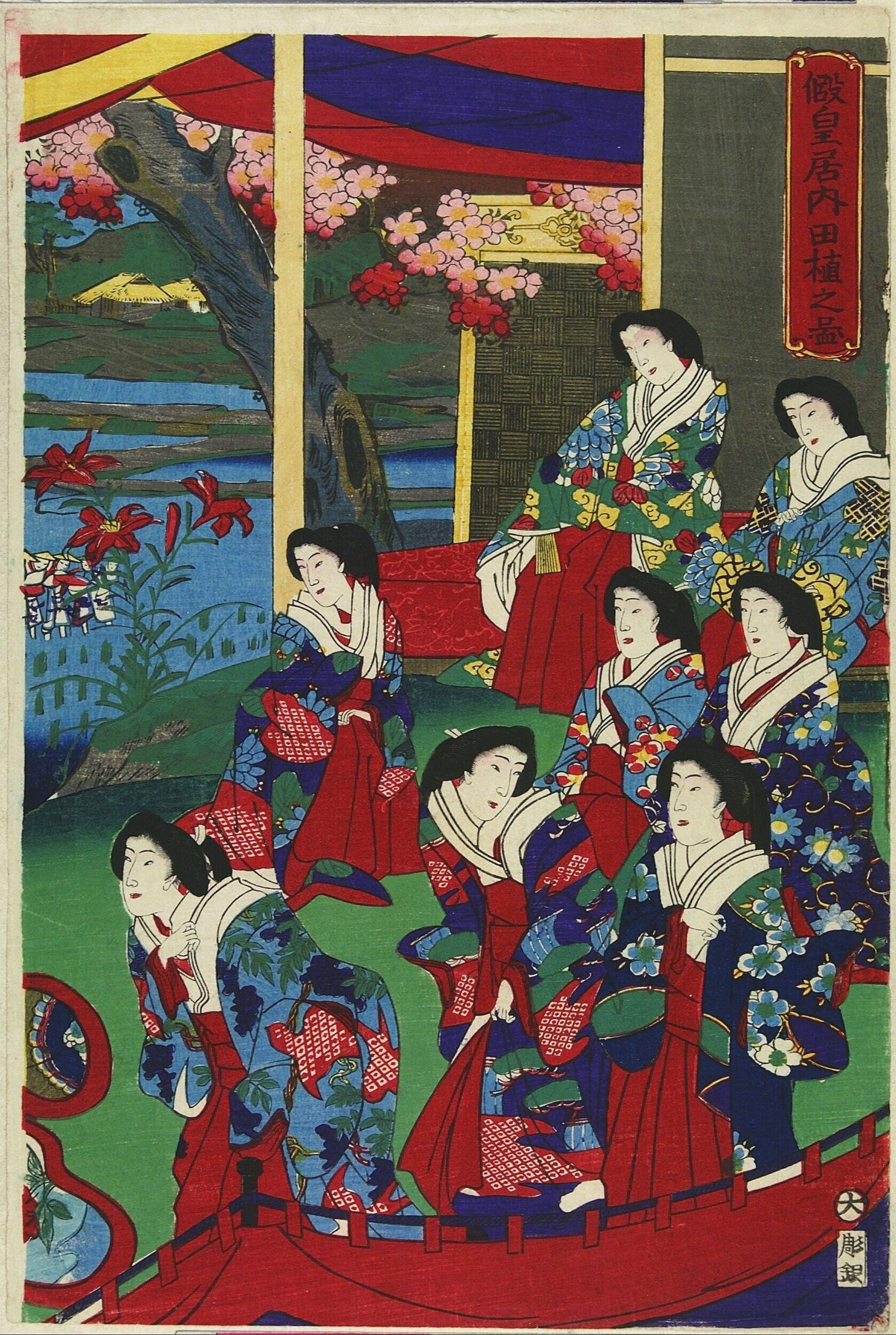
Untitled
1878
Picture of the Prosperity of Shintomiza
1879 (Meiji 12)
Woodblock print (nishiki-e) triptych; ink and color on paper
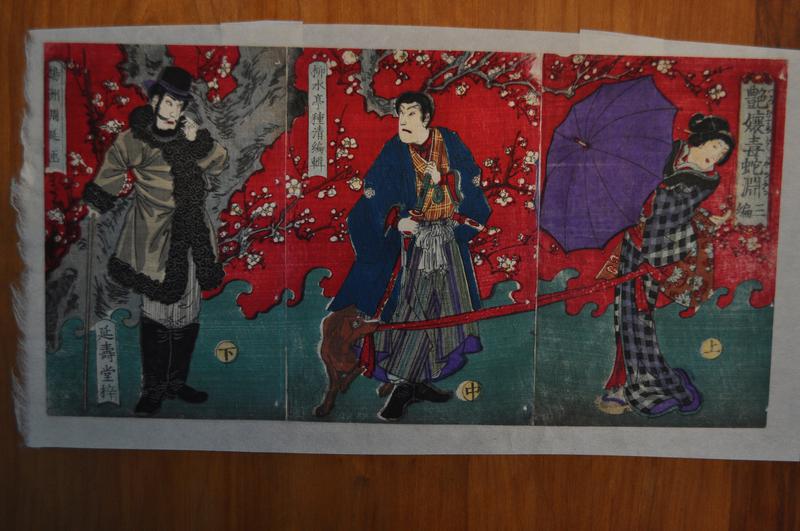
Covers of the three booklets Bright Young Girl in the Abyss of a Poisonous Snake, vol. 3
1880
Woodblock print (nishiki-e), ink and color on paper

Racetrack at Shinobazu Pond in Ueno
1885
Color woodblock prints; triptych
Dignitaries of the Empire Viewing Cherry Blossoms
1887 (Meiji 20)
Woodblock print (nishiki-e) triptych; ink and color on paper
A Collection of Pictures of Chignon Hairstyles (Kazura tsuke sokuhatsu zukai)
1887 (Meiji 20)
Woodblock print (nishiki-e); ink and color on paper
Singing by the Plum Garden
1887 (Meiji 20)
Woodblock print (nishiki-e) triptych; ink and color on paper
Triptych: Ueno Shinobazu Horserace
Meiji period, 1890
Woodblock-printed "ōban" triptych; ink and color on paper
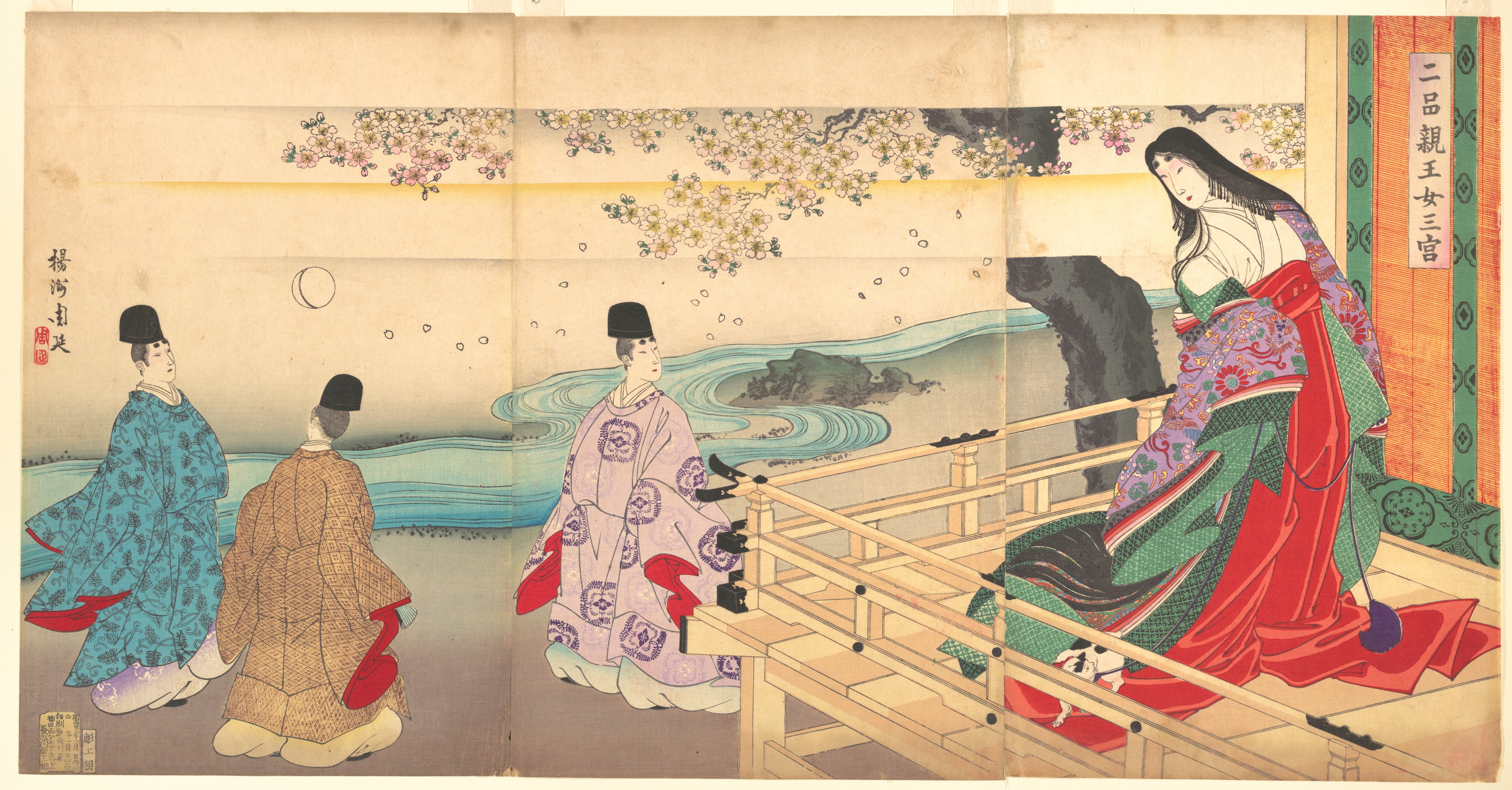
The Third Princess and Kashiwagi, from Chapter 34, “New Herbs I (Wakana I)” (Nihon shinnō onna sannomiya)
1890
Triptych of woodblock prints; ink and color on paper
Woman with Chrysanthemums
Meiji period, circa 1890s
Woodblock print in "ōban" format; ink and color on paper
Woman and Girl with Toy
Meiji period, circa 1890s
Woodblock print in "ōban" format; ink and color on paper
Session of the National Diet
1890 (Meiji 23)
Woodblock print (nishiki-e) triptych; ink and color on paper
Triptych: Chrysanthemums at Court
Meiji period, 1890
Woodblock-printed "ōban" triptych; ink and color on paper
Triptych: Port Festival Scene
Meiji period, 1890
Woodblock-printed "ōban" triptych; ink and color on paper
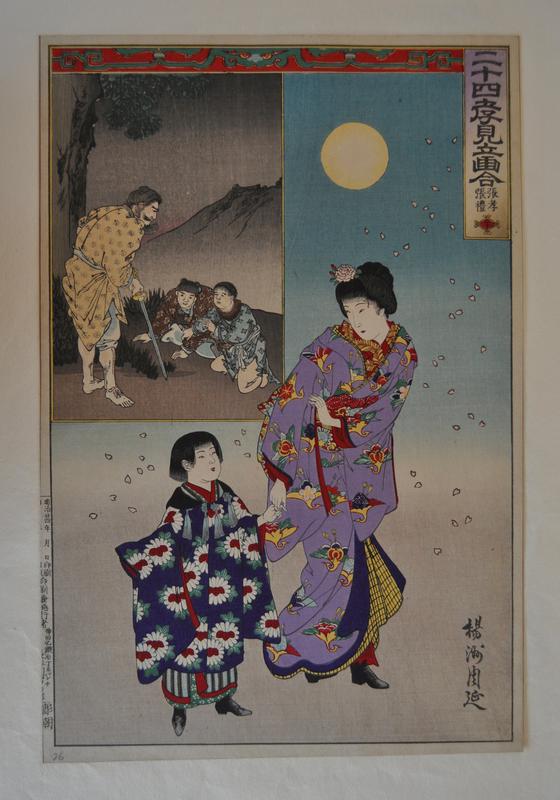
No. 20: Chо̄kо̄ and Chо̄rei
1891
Woodblock print (nishiki-e), ink and color on paper

Japanese Warship, Sinking Qing Ship
August 1894
Woodblock print (nishiki-e), ink and color on paper

Capturing the Fortress at Niuzhuang (Gyusojo senryo)
1895
Color woodblock print; oban triptych
Woman Red with White Chrysanthemums, from the series The Appearance of Upper-Class Women of the Edo period (Tokugawa jidai kifujin no sugata)
Meiji period, dated October 1895
Woodblock print in "ōban" format; ink and color on paper

Picture of the Fierce Battle at Taipingshan during the Sino-Japanese War
1895, 02?
Woodblock print (nishiki-e), ink and color on paper
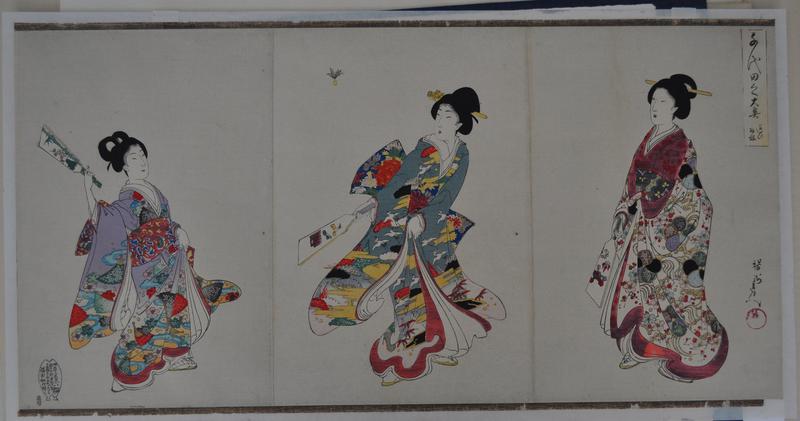
Battledore
1896
Woodblock print (nishiki-e), ink and color on paper
Resembling a Branch (Eda ni utsusu), from the series The Appearance of Upper-Class Women of the Edo Period (Tokugawa jidai kifujin no sugata) -- Woman with a Doll
Meiji period, dated October 10, 1896
Woodblock print in "ōban" format; ink and color on paper
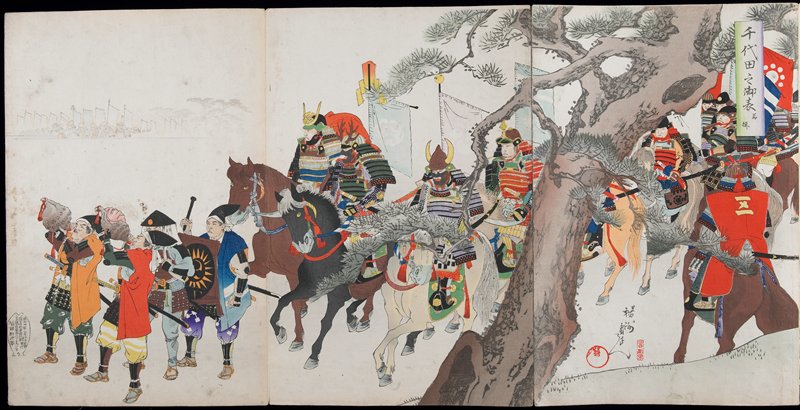
Public Appearances of Shōgun
1897
Woodblock print, ink and color on paper

Imperial inspection of the signal fires
1897
Woodblock print (nishiki-e), ink and color on paper
Arranging Flowers (Ikebana), from the series The Appearance of Upper-Class Women of the Edo Period (Tokugawa jidai kifujin no sugata)
Meiji period, datable to September 1, 1900
Left panel from an ukiyo-e woodblock-printed "ōban" triptych; ink and color on paper
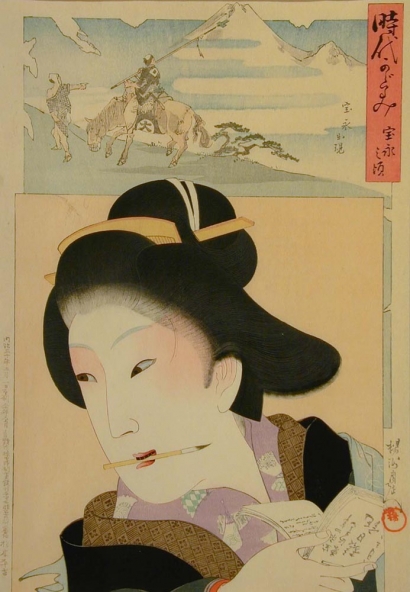
Lady of the Houei Era (1704-1711)
Woodblock print
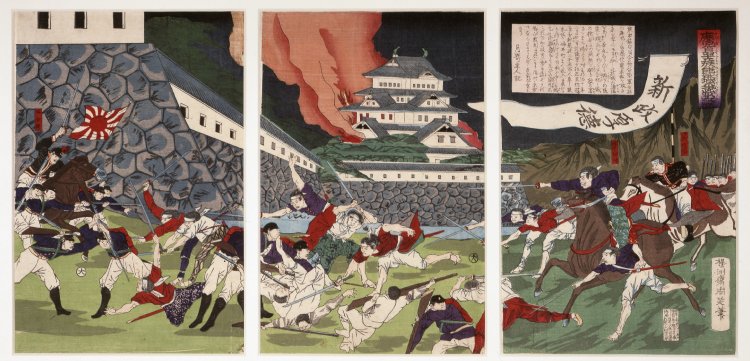
Kagoshima shizoku Kumamoto-jo senso no zu
Woodblock print
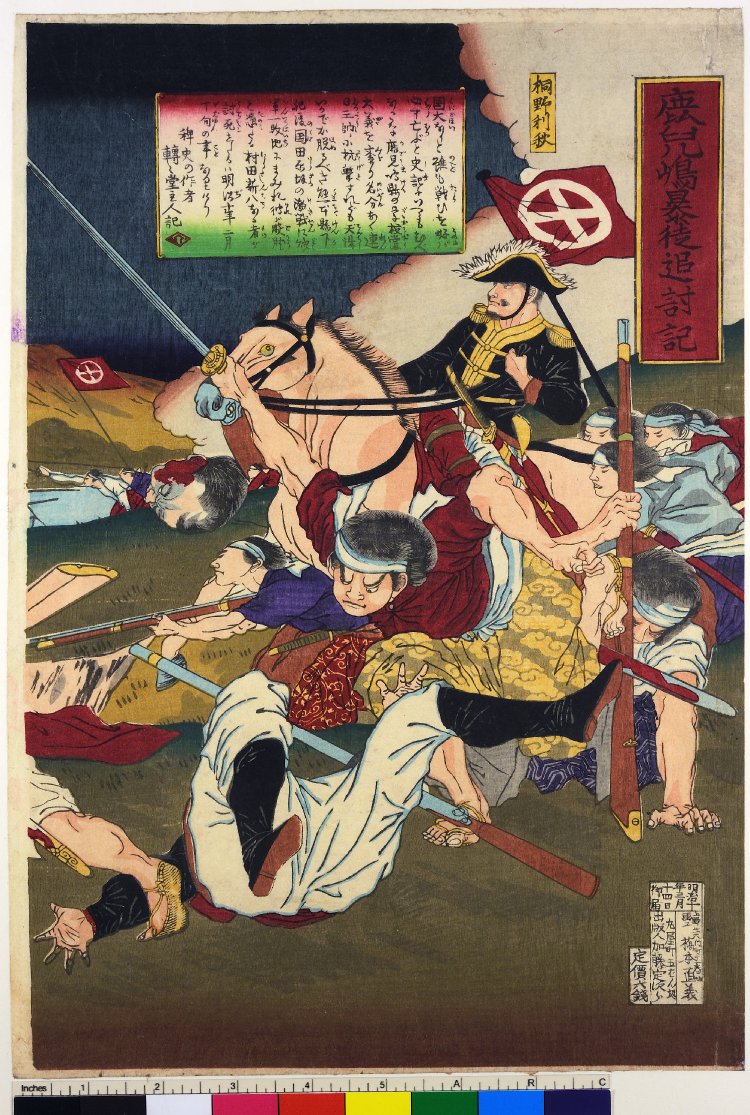
Kagoshima boto tsuito ki
Woodblock print

Woman Taking Tea, from the series Customary Japanese Female Ettiquette
Woodblock print
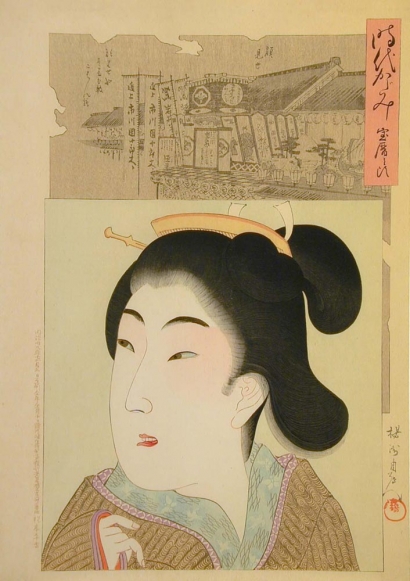
Lady of the Houreki Era (1751-1764)
Woodblock print
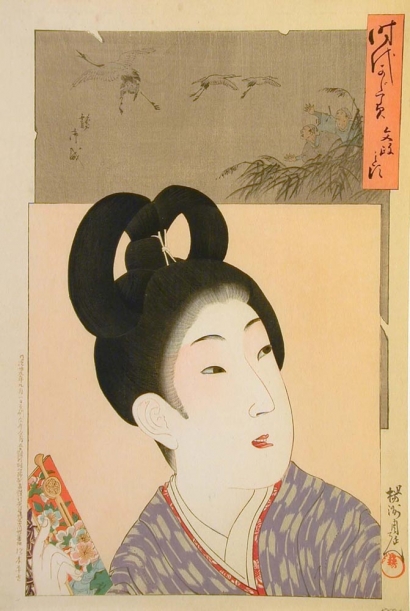
Lady of the Bunsei Era (1818-1830)
Woodblock print
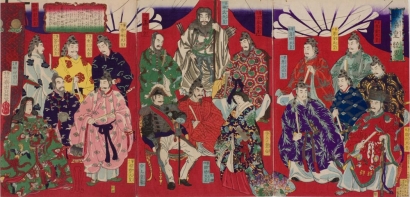
Imperial Lineage
Woodblock print
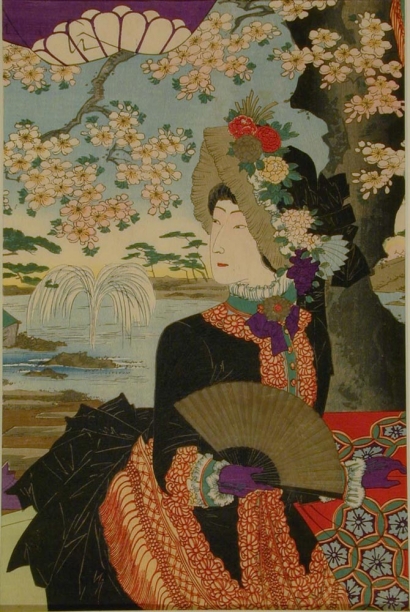
Empress Shoken in Western Dress and Bonnet
Woodblock print
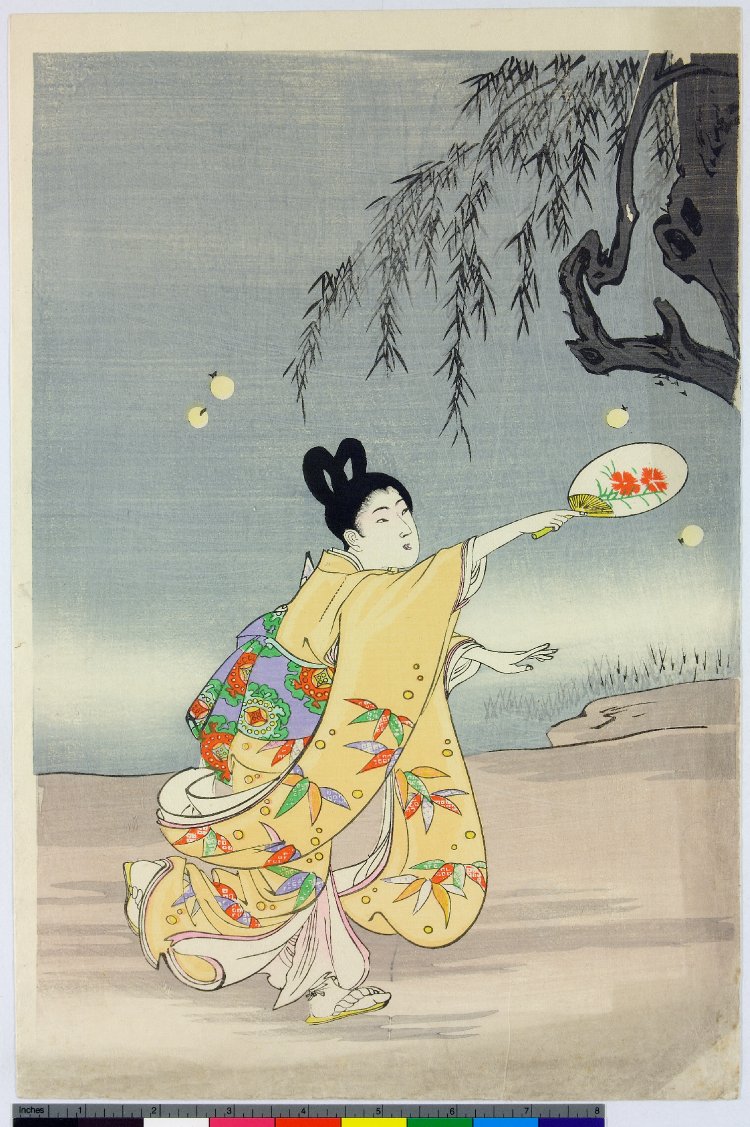
triptych print
Woodblock print
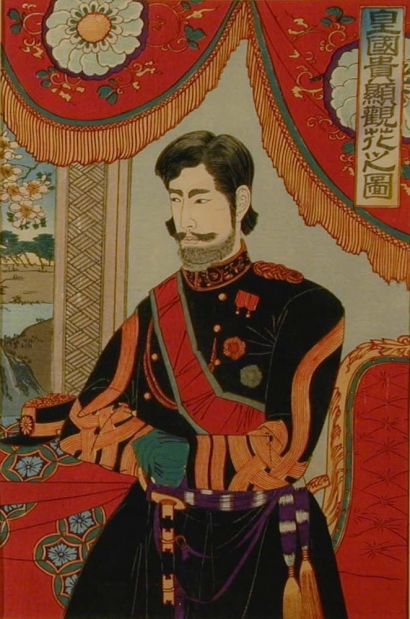
Emperor Meiji in Western Dress
Woodblock print
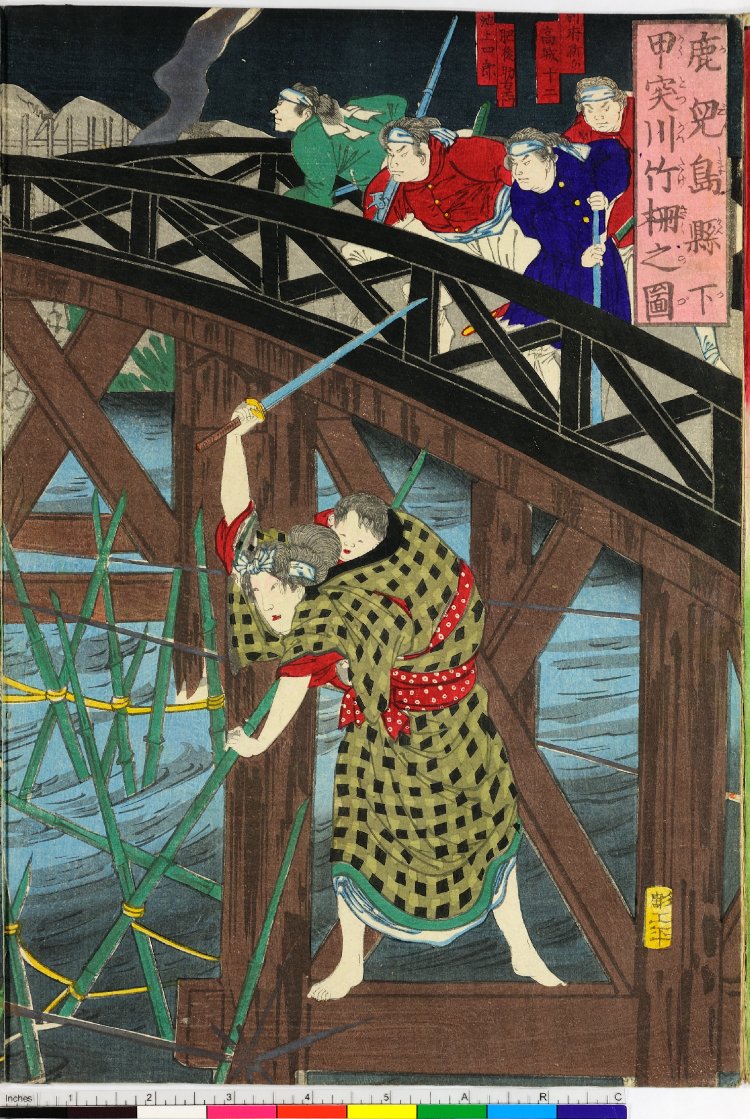
Kagoshima kenka koutotsu kawatake saku no zu 鹿児島縣下甲突川竹柵之図
Woodblock print
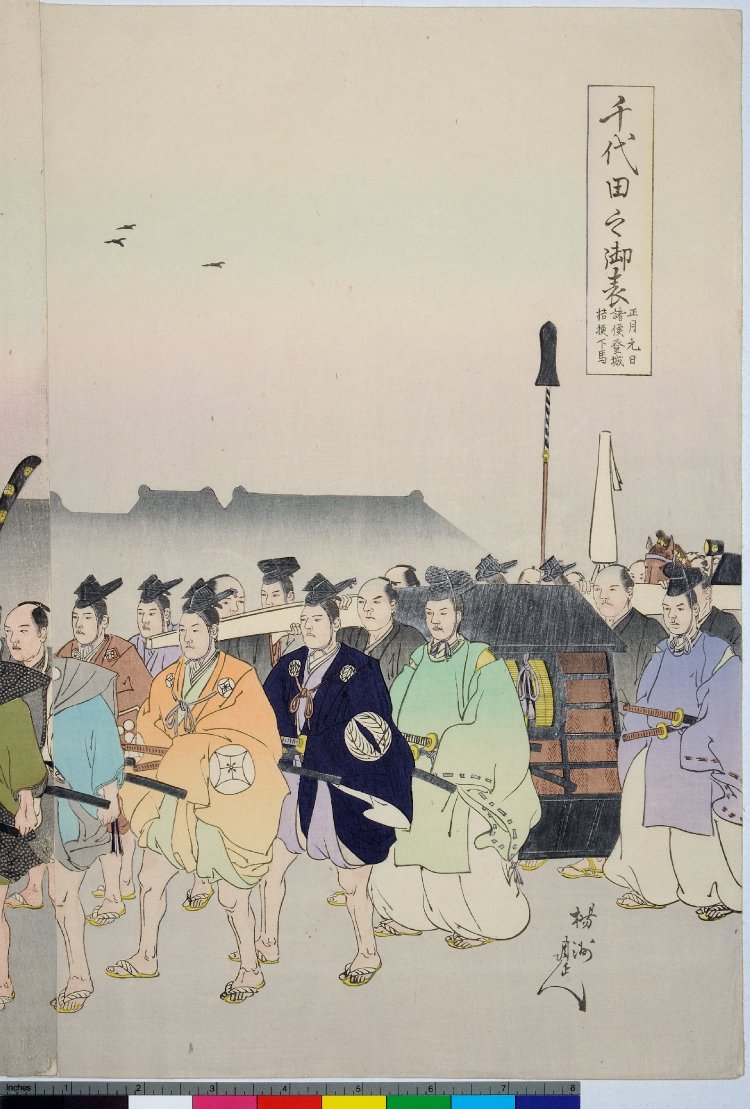
toyohara-chikanobu
Woodblock print

In the Great Sino-Japanese War, Our Navy Has a Great Victory
Woodblock print
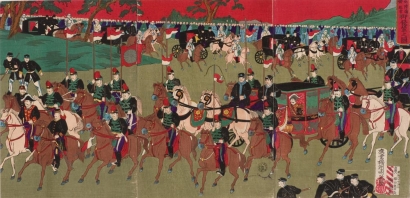
Emperor Meiji Leaving for Northern Japan
Woodblock print
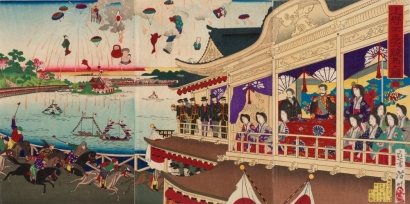
Emperor Meiji and Empress at Horse Races
Woodblock print
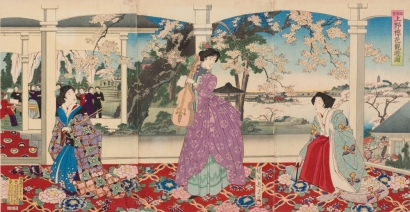
Dance Party: Enjoying Cherry Blossom Viewing at Ueno
Woodblock print
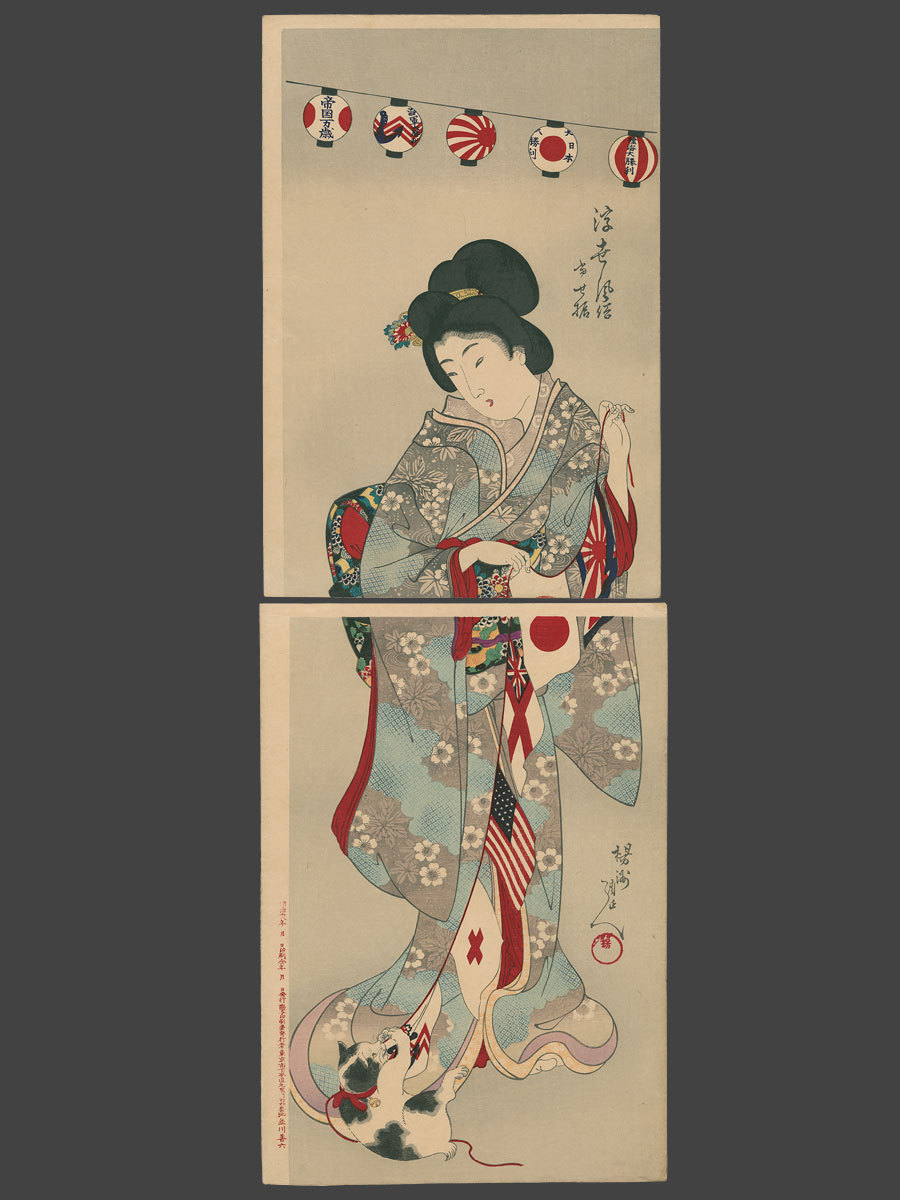
Beauty with a Cat playing with a String of flags
Woodblock print
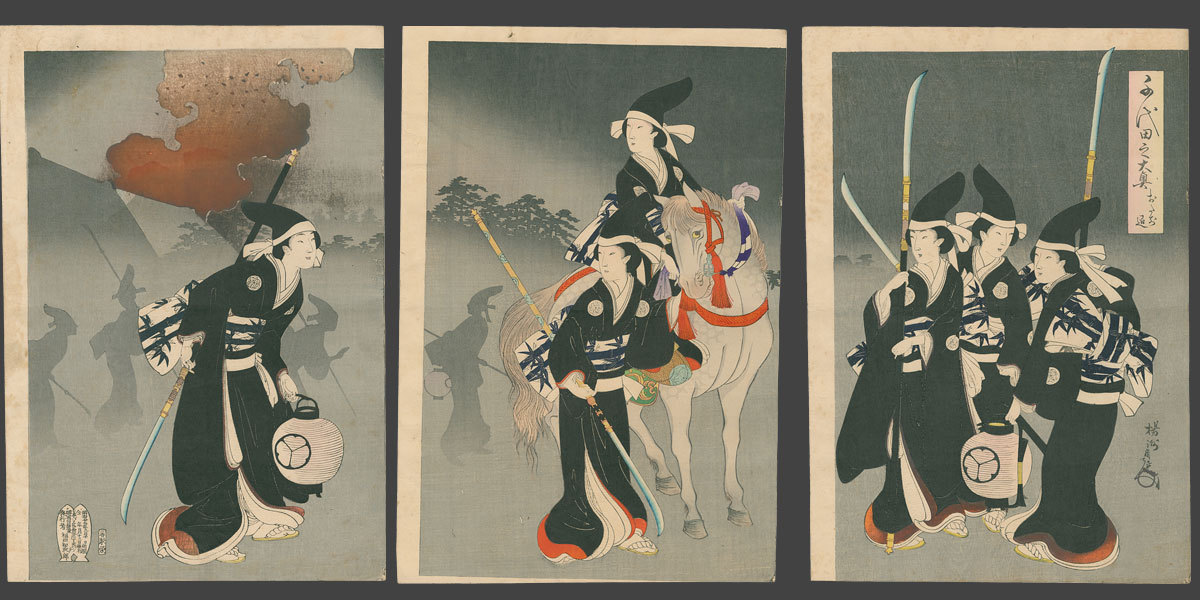
Women Naginata Warriors, Gaurdians of the Chiyoda Palace, Covering the Retreat from a Burning Castle
Woodblock print
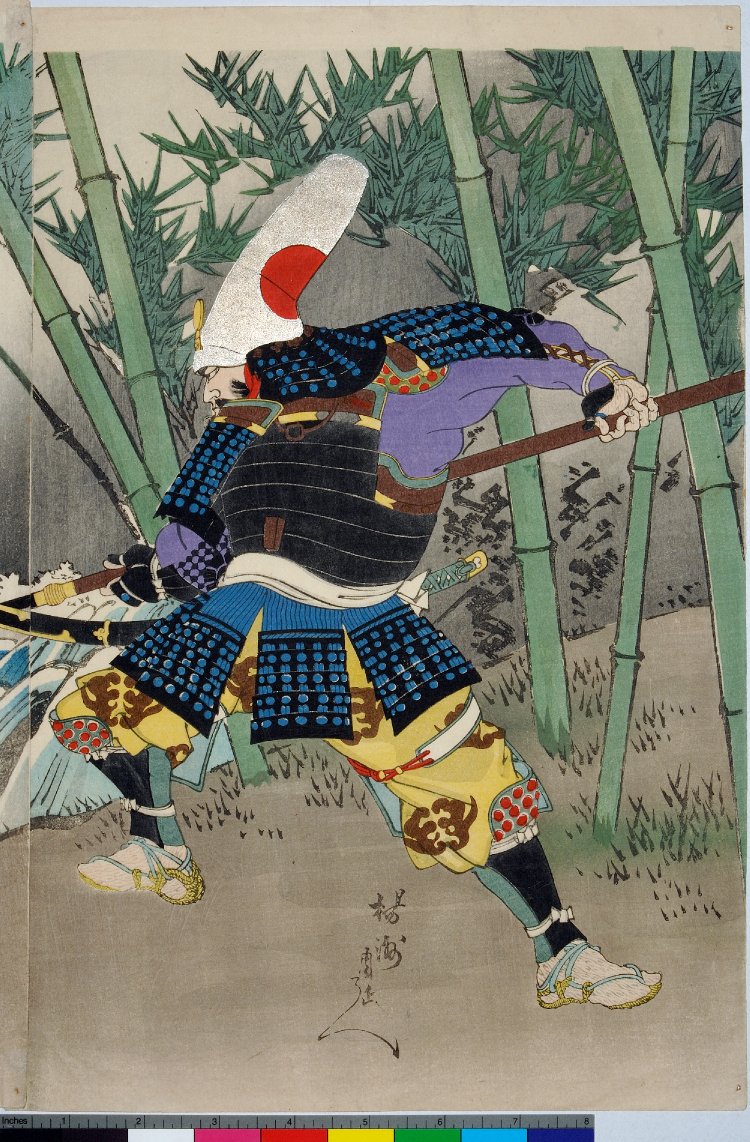
totalCount
Woodblock print
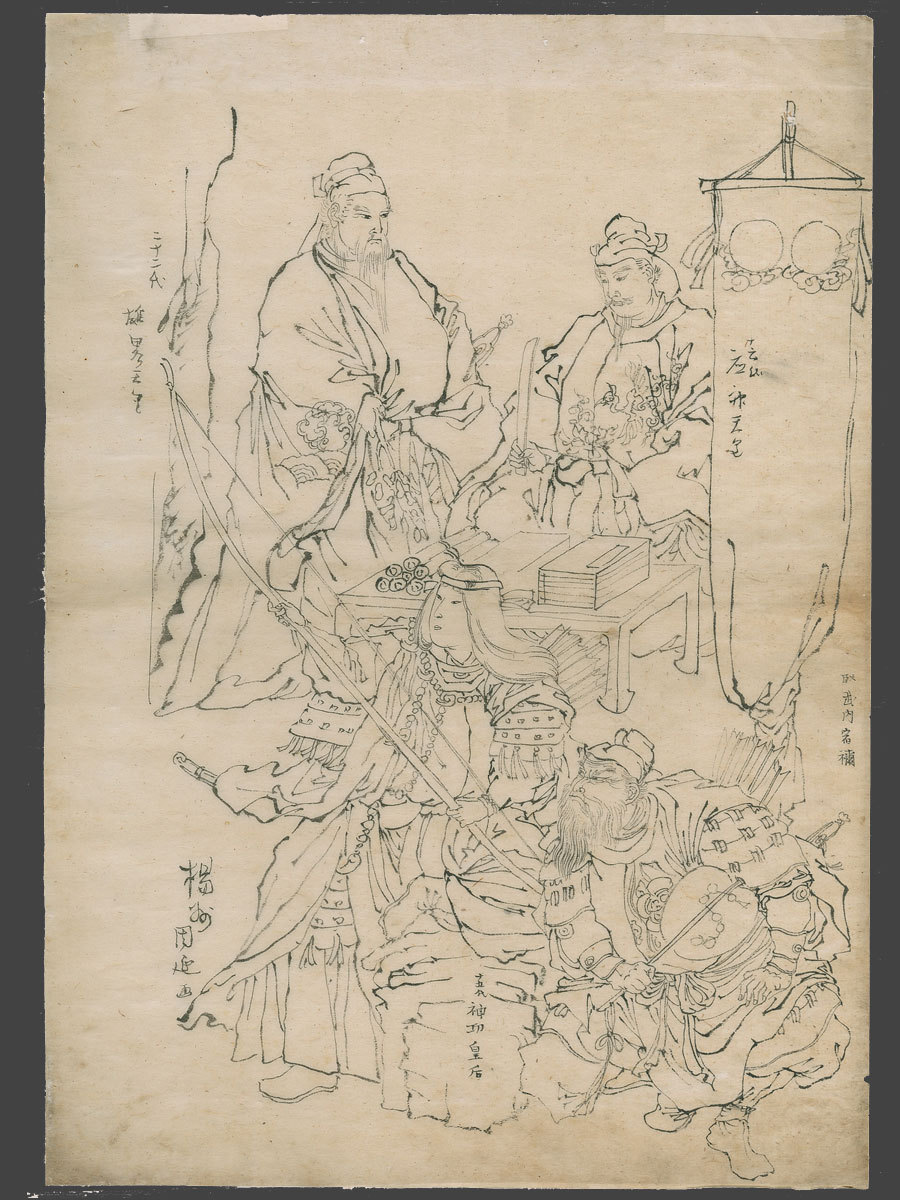
Preparatory Drawing for a Print Of Japanese Emperors and Empresses
Woodblock print
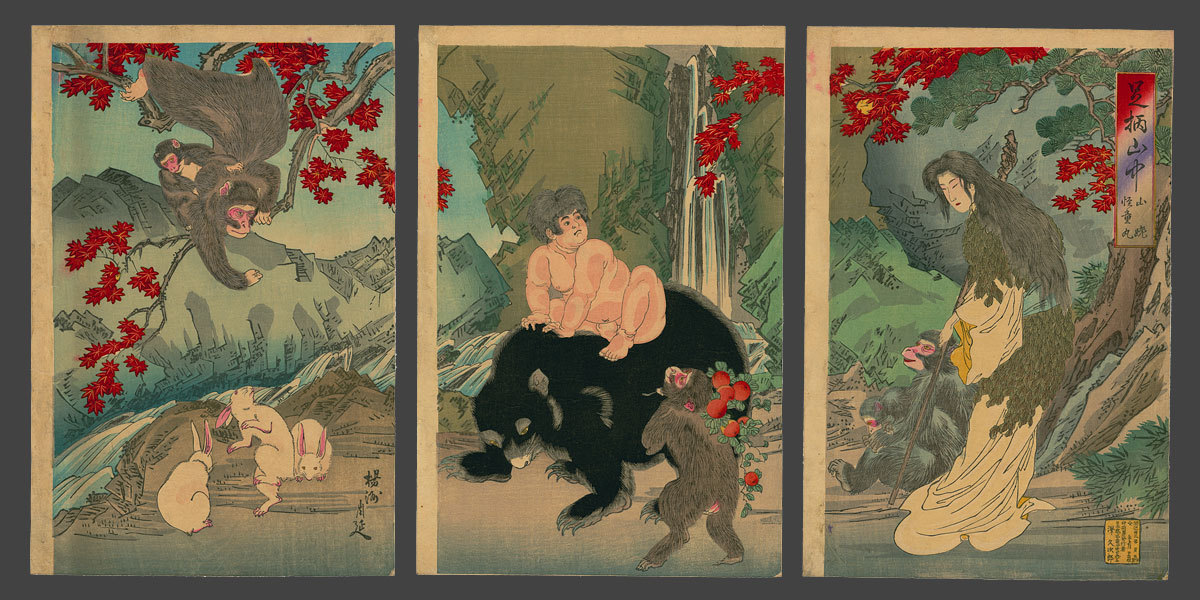
Yama Uba Watching a Young Kintoki Play with his Mountain Friends
Woodblock print
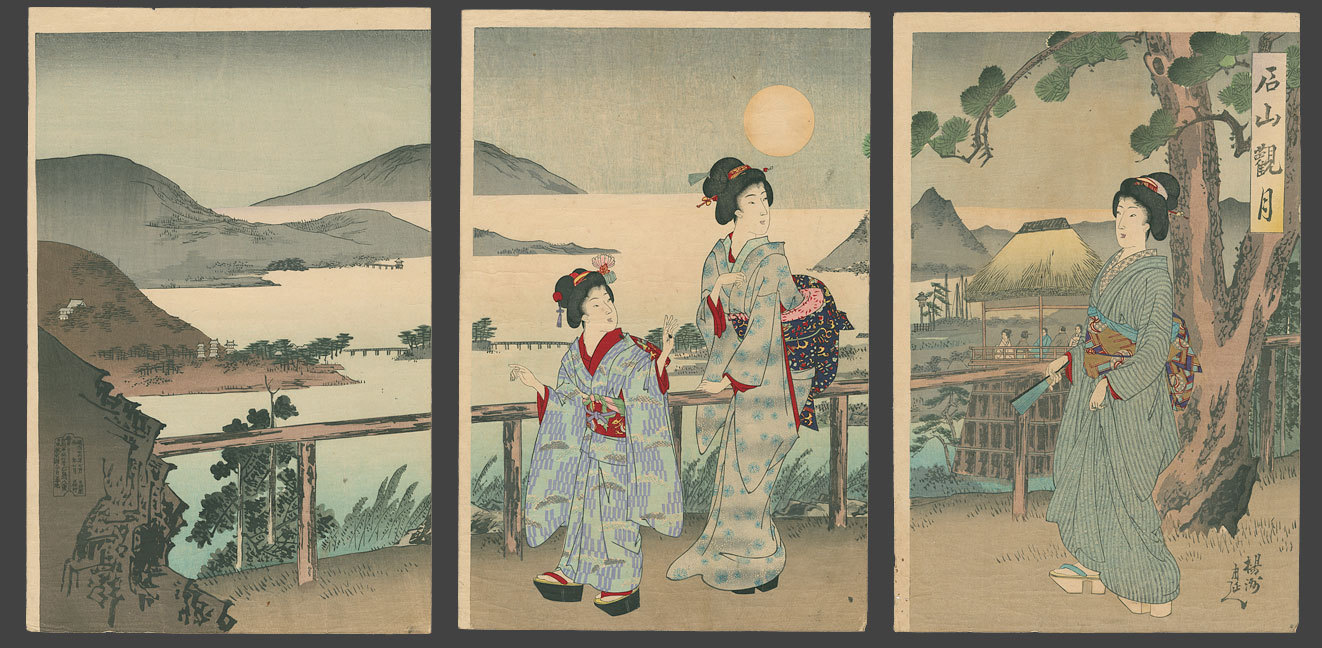
Moon Viewing at Ishiyama
Woodblock print
View from Castle
Woodblock print
Qing Chinese Snipers Aiming at Japanese Commander
Woodblock print
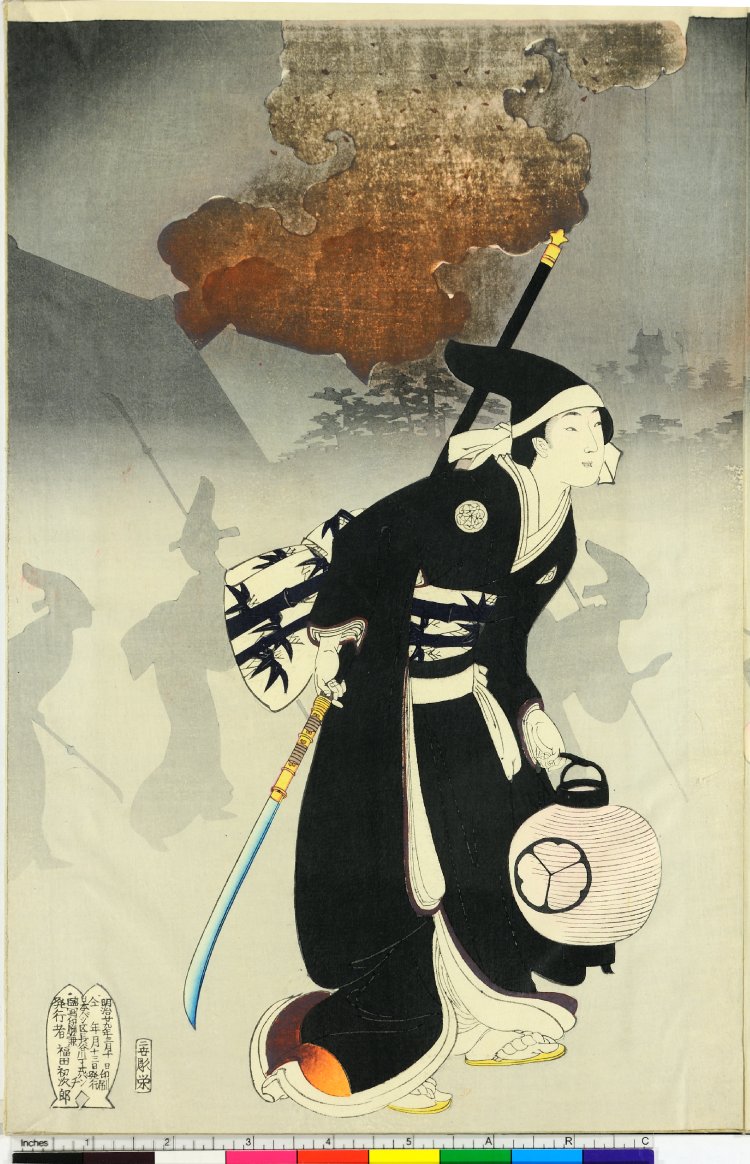
Chiyoda no o-oku
Woodblock print
Palanquin
Woodblock print
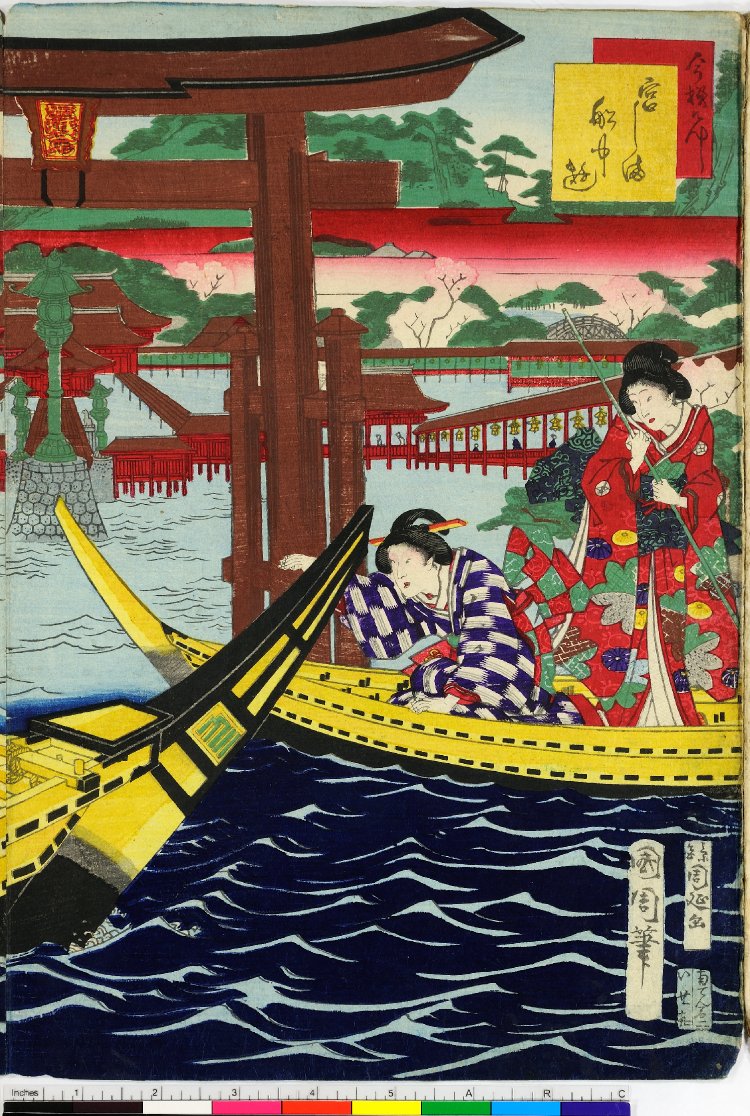
Imayo Genji 今様げんじ / Miyashima senchu asobi 宮しま船中遊
Woodblock print

Meiji shoshi nenkai kiji
Woodblock print
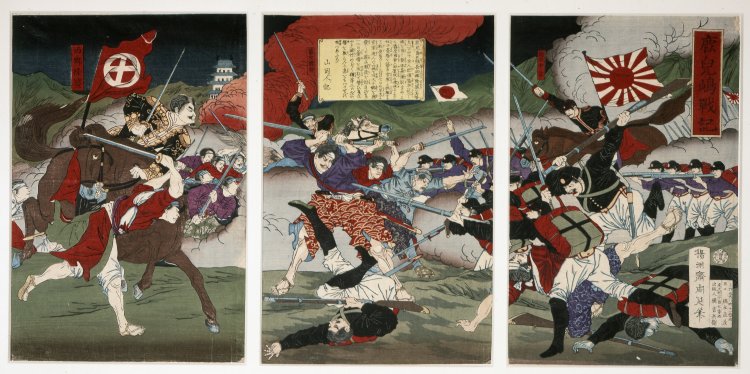
Kagoshima senki
Woodblock print
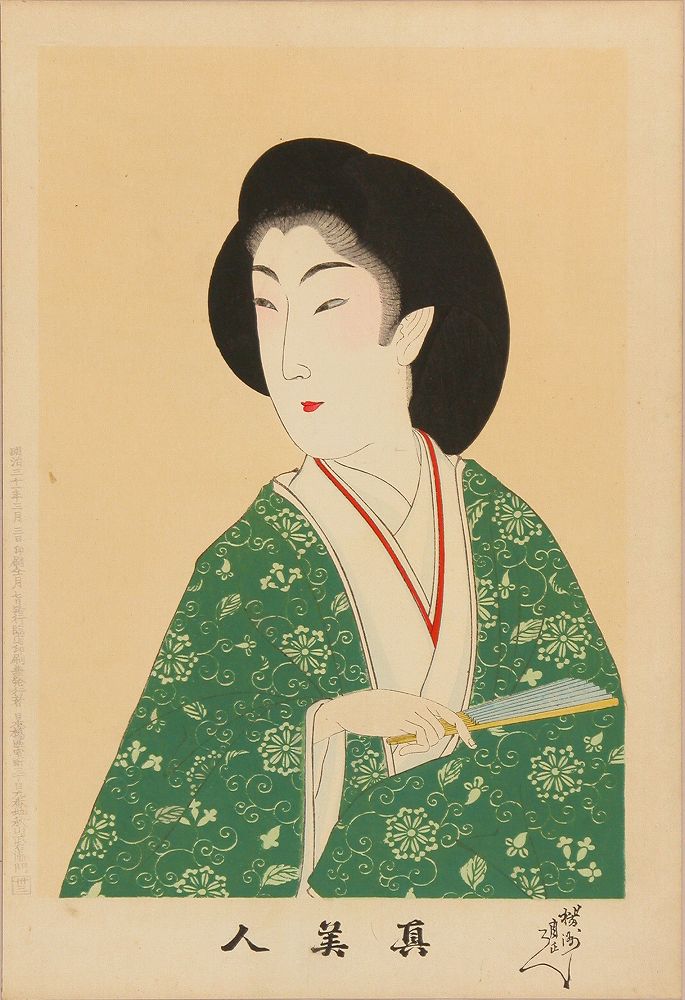
No. 33, from
Woodblock print
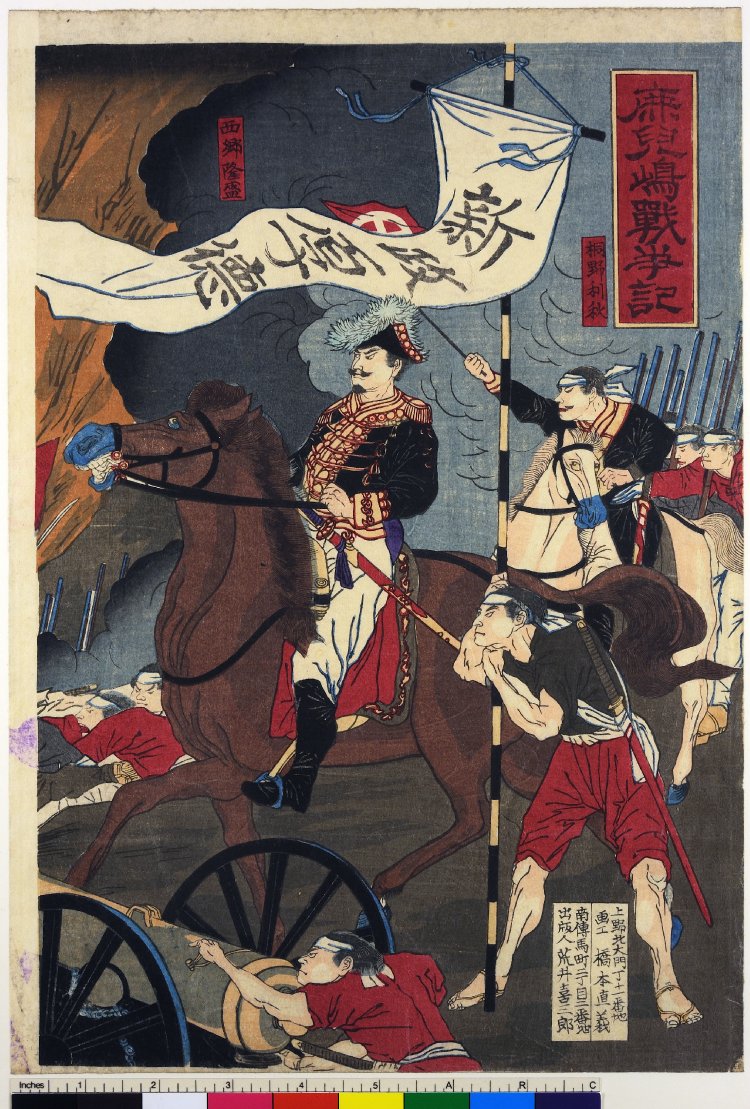
Kagoshima senso ki (Record of the war in Kagoshima)
Woodblock print
Nobleman Boating
Woodblock print
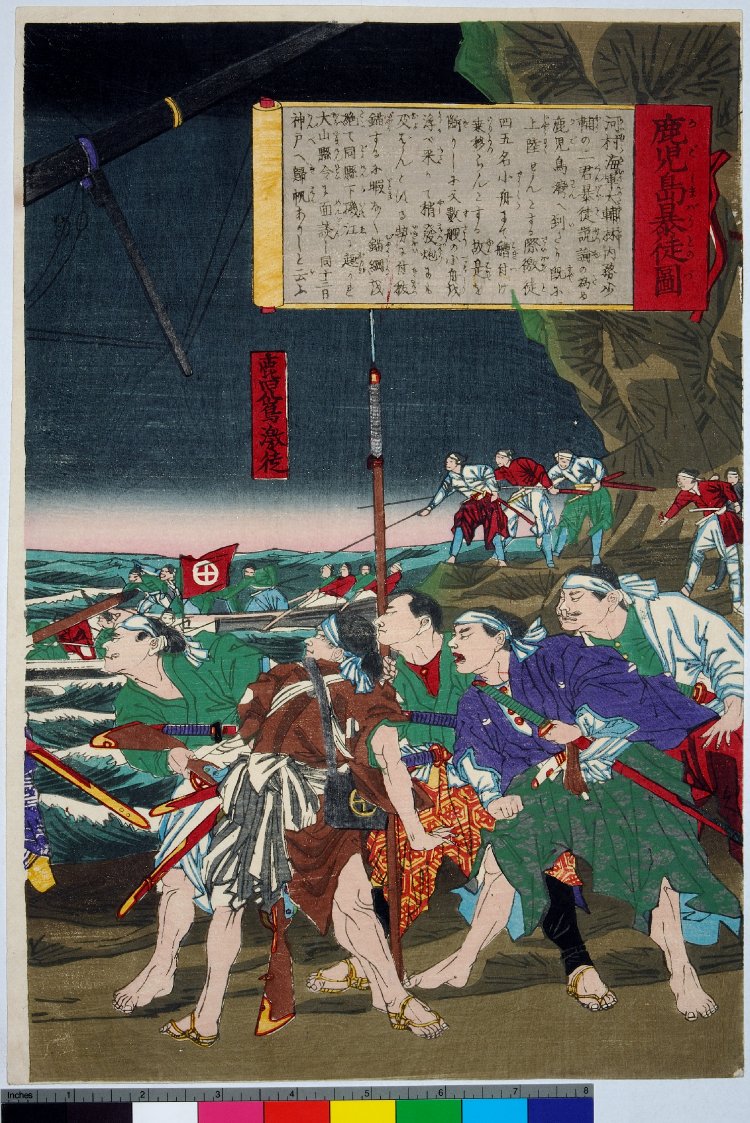
Kagoshima boto no zu
Woodblock print
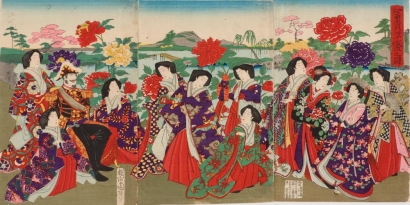
Meiji Emperor and Empress in Peony Garden
Woodblock print
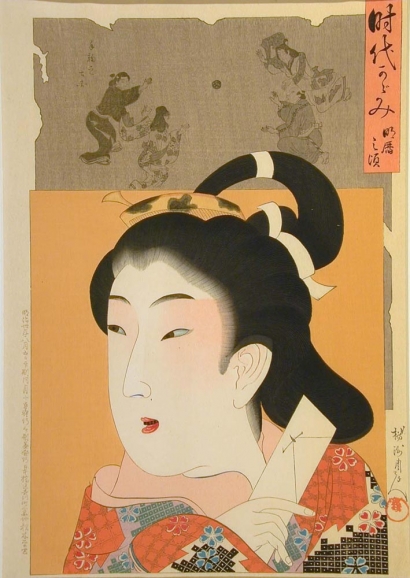
Lady of Meireki Era (1655-58)
Woodblock print