Biography
Kitagawa Utamaro (喜多川歌麿, c. 1753–1806) stands as the supreme master of bijin-ga, the art of depicting beautiful women in the Japanese woodblock print tradition. Working at the height of the ukiyo-e movement in the late eighteenth century, Utamaro transformed the genre from formulaic representations of courtesans and entertainers into penetrating psychological studies of femininity. His invention of the okubi-e format — large-head bust portraits that filled the picture plane with a single face — represented a radical departure from existing conventions and produced some of the most iconic images in the history of Japanese art.
The details of Utamaro's early life remain frustratingly obscure. He was born around 1753, though some scholars place his birth as early as 1750 or as late as 1754. His birthplace is disputed, with Edo (present-day Tokyo), Kawagoe, Kyoto, and Osaka all proposed by various authorities. Even his original family name is uncertain; Kitagawa may have been adopted from his teacher or assumed later in his career.
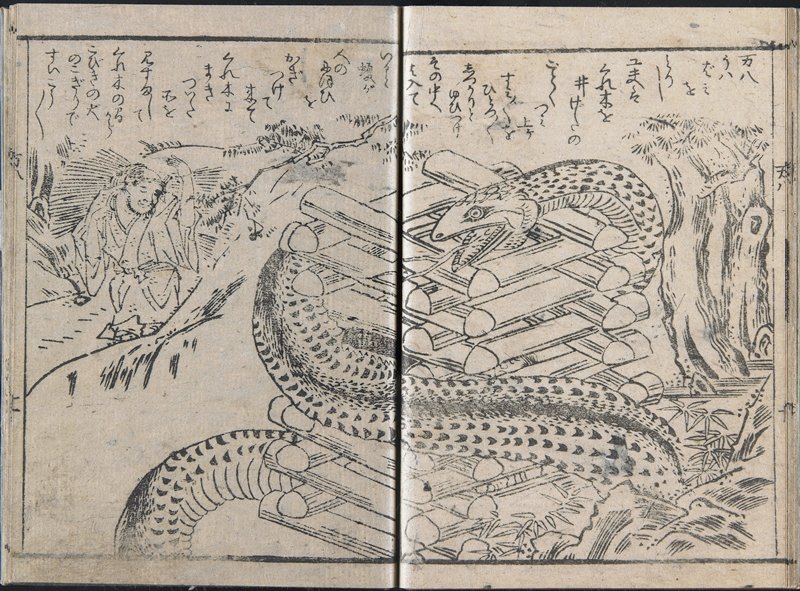
Utamaro's artistic training almost certainly began under Toriyama Sekien, a painter of the Kano school who had turned to ukiyo-e and was known for his illustrated books of supernatural creatures and folklore. Under Sekien's tutelage, Utamaro received thorough grounding in brushwork, composition, and the conventions of both classical Japanese painting and the more populist ukiyo-e tradition. His earliest known works, produced under the art name Kitagawa Toyoaki, date from the mid-1770s and consist primarily of modest illustrations for popular fiction and theatrical prints of kabuki actors. By the early 1780s, he had adopted the name Utamaro and was beginning to develop a more distinctive voice, particularly in his illustrated books of natural history, including detailed studies of insects, birds, and shells that demonstrated his exceptional powers of observation.
The decisive turning point came through his association with Tsutaya Juzaburo, the most ambitious and artistically discerning publisher in Edo. Tsutaya, whose shop stood at the entrance to the Yoshiwara pleasure quarter, had an unerring instinct for commercial potential. Beginning around 1789 or 1790, the partnership deepened into an artistic collaboration. Tsutaya provided Utamaro with the finest materials — premium pigments, skilled carvers, experienced printers, and luxurious paper — while encouraging him to pursue his most experimental ideas.
Utamaro's great innovation came in the early 1790s with his development of the okubi-e format for portraying beautiful women. Where previous bijin-ga artists had typically shown their subjects at full length, situated within identifiable settings and defined largely by their elaborate costumes, Utamaro brought the viewer startlingly close. His bust portraits cropped the figure at the chest or shoulders and enlarged the face to fill the sheet, often against a plain ground of mica or pale color. This radical simplification directed attention entirely to the woman's face and expression.
In series such as Fujin Sogaku Juttai (Ten Studies in Female Physiognomy) and Kasen Koi no Bu (Anthology of Poems: The Love Section), Utamaro used the subtlest means — the angle of a glance, the set of the lips, the tilt of the head — to suggest distinct psychological states. His prints conveyed contemplation, longing, vanity, tenderness, and quiet amusement with a sophistication that had no precedent in the popular print tradition.
The 1790s represented Utamaro's period of supreme achievement. His subjects ranged from named courtesans of the Yoshiwara to anonymous women of the townsman class engaged in everyday activities. His triptych Women Engaged in the Sericulture Industry depicted the stages of silk production with monumental dignity. He also produced accomplished shunga (erotic prints), including the celebrated Utamakura (Poem of the Pillow, 1788), which combined frank sensuality with extraordinary compositional refinement.
The death of Tsutaya Juzaburo in 1797 deprived Utamaro of his greatest champion. Though he continued to produce work for other publishers, some scholars detect a gradual coarsening in his output after this date.
In 1804, Utamaro produced a triptych depicting the historical figure Toyotomi Hideyoshi feasting with his concubines. The Tokugawa shogunate, acutely sensitive to any depiction sympathetic to the Toyotomi legacy, arrested Utamaro. He was sentenced to fifty days in manacles — a punishment involving heavy wooden restraints that prevented him from drawing. Though he resumed work after his release, contemporaries noted a profound change in his demeanor and output. He died on October 31, 1806, in Edo.
Utamaro's work was among the first Japanese art to reach Europe in significant quantities after Japan opened to international trade. His flattened pictorial space, bold outlines, and subtle color harmonies exerted a powerful influence on Western modernism. Edgar Degas adopted his unconventional vantage points. Mary Cassatt drew directly on his mother-and-child compositions. Art Nouveau designers found in his flowing lines a model for their synthesis of fine and applied art. Utamaro's achievement was to bring the full resources of artistic genius to the depiction of beautiful women, transforming commercial entertainment into penetrating human portraiture.
Key Facts
- Active Period
- 1753–1806
- Movement
- Ukiyo-e
- Works Indexed
- 198
Frequently Asked Questions
What is Kitagawa Utamaro known for?
Kitagawa Utamaro (喜多川歌麿, c. 1753–1806) stands as the supreme master of bijin-ga, the art of depicting beautiful women in the Japanese woodblock print tradition. Working at the height of the ukiyo-e movement in the late eighteenth century, Utamaro transformed the genre from formulaic representations of courtesans and entertainers into penetrating psychological studies of femininity. His invention of the okubi-e format — large-head bust portraits that filled the picture plane with a single face — represented a radical departure from existing conventions and produced some of the most iconic images in the history of Japanese art.
When was Kitagawa Utamaro active?
Kitagawa Utamaro was active from 1753 to 1806. They were associated with the Ukiyo-e movement.
What artistic movements influenced Kitagawa Utamaro?
Kitagawa Utamaro's work was shaped by the Ukiyo-e tradition in Japanese woodblock printmaking. Ukiyo-e: Ukiyo-e ("pictures of the floating world") is the dominant tradition of Japanese woodblock printing, flourishing from the seventeenth through nineteenth centuries.
Where can I see Kitagawa Utamaro's original prints?
Original prints by Kitagawa Utamaro can be found in collections including Cleveland Museum of Art, Harvard Art Museums, Art Institute of Chicago, Victoria and Albert Museum.