
Biography
Yozo Hamaguchi (浜口陽三, 1909–2000) was a Japanese printmaker universally recognized as one of the greatest masters of the mezzotint technique in the history of the medium. Working primarily in Paris and later in San Francisco, Hamaguchi devoted his career to the painstaking art of mezzotint — an intaglio technique that works from dark to light by laboriously roughening the entire surface of a copper plate and then selectively burnishing and scraping it to create images of extraordinary tonal richness. His still life compositions of fruits, butterflies, insects, and simple objects achieve a luminous, jewel-like quality that is unmatched in twentieth-century printmaking.
Born in 1909 in Wakayama Prefecture, Japan, Hamaguchi was the son of a prominent soy sauce manufacturing family. He studied sculpture at the Tokyo School of Fine Arts before moving to Paris in 1930, drawn by the artistic opportunities of the French capital. In Paris, he initially pursued painting and sculpture before discovering the mezzotint technique, which would become his life's work.
The mezzotint medium was an unlikely choice for a Japanese artist in the 1930s. The technique, invented in the seventeenth century, had fallen largely out of use by the twentieth century, dismissed by most printmakers as too laborious and technically demanding for contemporary art. Hamaguchi's decision to revive and master this near-forgotten medium was a testament to both his artistic vision and his extraordinary patience and discipline. The mezzotint process requires the artist to rock a serrated tool across the plate thousands of times to create a uniform burr that will hold ink for a rich, velvety black. The image is then created by burnishing away this burr to create areas of lighter tone — a process that is the reverse of most printmaking techniques, working from darkness toward light.
Hamaguchi's mature work, which began to achieve international recognition in the 1950s, is characterized by its extraordinary technical perfection and its deceptively simple subject matter. His still life compositions typically feature one or a few objects — a cluster of cherries, a single walnut, a butterfly, a lemon, a ladybug — isolated against dark or subtly gradated backgrounds. These humble subjects are transformed by the mezzotint technique into images of astonishing beauty, their surfaces glowing with an inner luminosity that seems almost supernatural. The cherries gleam with reflected light, the butterfly's wings display every subtle marking, the walnut's wrinkled shell becomes a landscape of ridges and valleys.
The color in Hamaguchi's mezzotints — achieved through multiple plates, each carrying a different hue — is equally remarkable. His palette is characteristically warm and rich, with deep reds, luminous yellows, and subtle greens that seem to emanate from within the paper rather than sitting on its surface. The seamless blending of colors that the mezzotint technique allows gives his prints a quality that approximates the glow of stained glass or the luminosity of gemstones.
Hamaguchi's work was recognized with major international awards, including the Grand Prize at the São Paulo Biennale in 1957, which brought him worldwide fame and helped spark renewed interest in the mezzotint technique among younger printmakers. He exhibited extensively in Paris, Tokyo, New York, and other major art centers, and his work was acquired by the world's leading museums and print collections.
His marriage to the etcher and aquatint artist Keiko Minami created a remarkable artistic partnership. The couple lived together in Paris for many years, each pursuing their distinctive printmaking vision while sharing a commitment to the highest standards of craft.
In his later years, Hamaguchi moved from Paris to San Francisco, where he continued to work until advanced age made the physically demanding mezzotint process impossible. He died in 2000 at the age of ninety-one. His prints are held in collections including the Museum of Modern Art in New York, the Bibliothèque Nationale de France, the British Museum, the National Museum of Modern Art in Tokyo, and the Musée de la Monnaie in Paris, where a major retrospective honored his achievement.
Key Facts
- Active Period
- 1909–2000
- Nationality
- 🇯🇵Japan
- Movement
- Sōsaku-hanga
- Works Indexed
- 27
Frequently Asked Questions
What is Yozo Hamaguchi known for?
Yozo Hamaguchi (浜口陽三, 1909–2000) was a Japanese printmaker universally recognized as one of the greatest masters of the mezzotint technique in the history of the medium. Working primarily in Paris and later in San Francisco, Hamaguchi devoted his career to the painstaking art of mezzotint — an intaglio technique that works from dark to light by laboriously roughening the entire surface of a copper plate and then selectively burnishing and scraping it to create images of extraordinary tonal richness. His still life compositions of fruits, butterflies, insects, and simple objects achieve a luminous, jewel-like quality that is unmatched in twentieth-century printmaking.
When was Yozo Hamaguchi active?
Yozo Hamaguchi was active from 1909 to 2000. They were associated with the Sōsaku-hanga movement.
What artistic movements influenced Yozo Hamaguchi?
Yozo Hamaguchi's work was shaped by the Sōsaku-hanga tradition in Japanese woodblock printmaking. Sōsaku-hanga: The "creative prints" movement (c.
Where can I see Yozo Hamaguchi's original prints?
Original prints by Yozo Hamaguchi can be found in collections including Art Institute of Chicago, Victoria and Albert Museum, Harvard Art Museums, Minneapolis Institute of Art.
How much do Yozo Hamaguchi prints cost?
Yozo Hamaguchi is universally recognized as the greatest mezzotint artist of the twentieth century, and his prints command the highest prices of any Japanese intaglio printmaker. His luminous still life compositions of fruits, butterflies, and simple objects have achieved iconic status in the printmaking world. Prices are substantial, reflecting both his artistic stature and the inherent scarcity of mezzotint editions. Hamaguchi's mezzotint technique produces very small editions (typically 30-60 impressions) because the copper plate's delicate burr wears down during printing. Early impressions are significantly more luminous and detailed than later ones, making impression number an important value factor. Color mezzotints, which required multiple plates and even more painstaking technique, command higher prices than black-and-white works. His cherry still lifes are the most iconic and valuable, followed by butterfly subjects and other fruit compositions. Works from the 1960s-1980s represent his peak period. Black-and-white works: $1,000–$3,000. Color still lifes: $3,000–$10,000. Major early-impression color works: $10,000–$30,000. The market for Hamaguchi is strong and has shown consistent appreciation over decades.
Woodblock Prints by Yozo Hamaguchi (27)

Cherries
n.d.
Color lithograph on cream wove paper, laid down on mat board

Pomegranate in Fruit Dish
n.d.
Mezzotint on white wove paper

Landscape
n.d.
Mezzotint on white wove paper

Still Life
1957
Mezzotint on white wove paper
Black Cherries
circa 1960
Mezzotint and drypoint

Black Cherry
ca. 1960-1961

Bouteilles et noix
1961

Green Poplars
1980–89
Color mezzotint

Crimson Butterfly
1981–90
Color mezzotint

Bottle with Lemon and Quarter Lemon
1983
Mezzotint

Bottle with Yellow Lemons in Darkness
1983–89
Color mezzotint

Three Butterflies
1985–91
Color mezzotint

Autumn Field
1985–92
Color mezzotint

Red Field
1985–91
Color mezzotint

Knitting Needle
1985
Mezzotint

Green Field
1985–92
Color mezzotint

Spring Morning
1985–92
Color mezzotint

Magenta Cherries
1988–91
Color mezzotint

Twenty-Two Cherries (XVII. someones married their everyones)
1988–91
Color mezzotint

Almost Symmetric
1994
Mezzotint
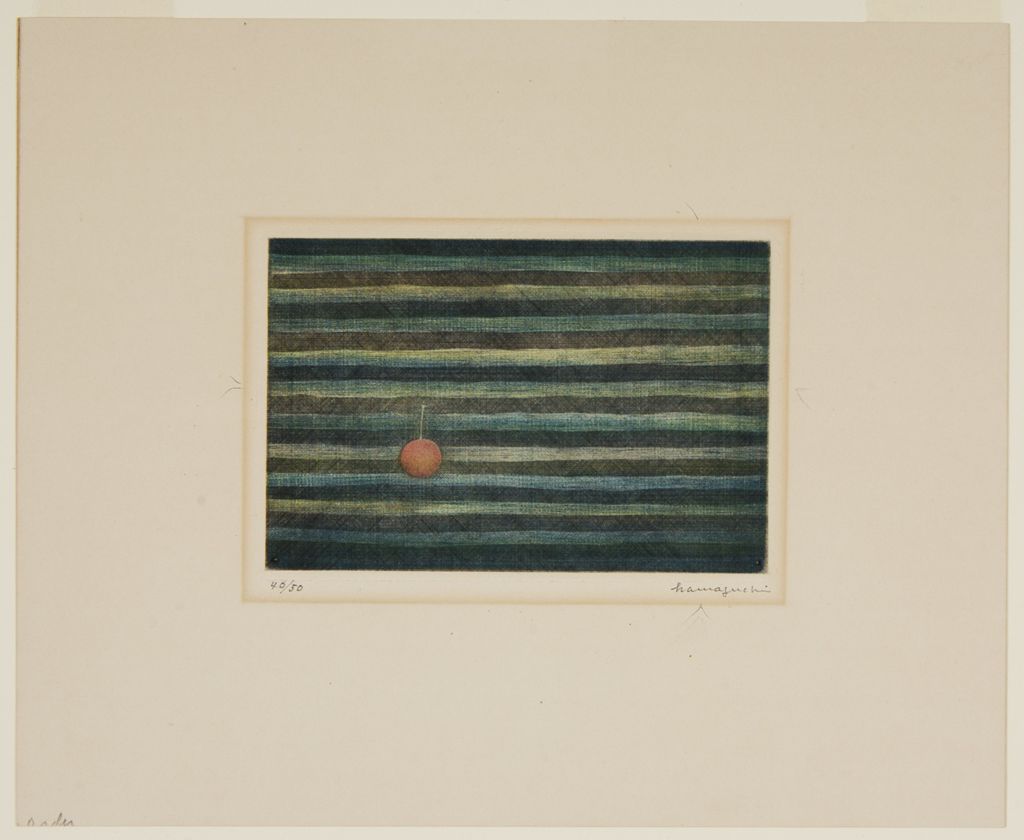
One Cherry, 1958
Woodblock print
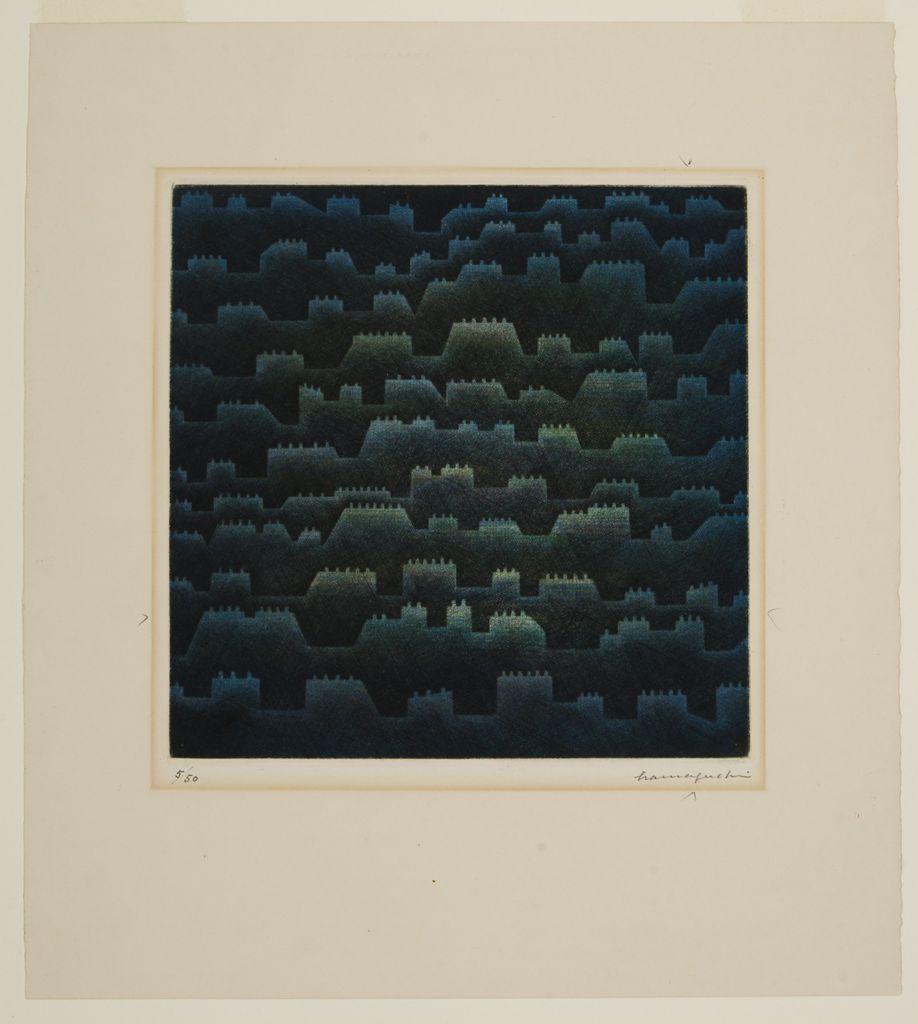
Roofs of Paris, 1956
Woodblock print
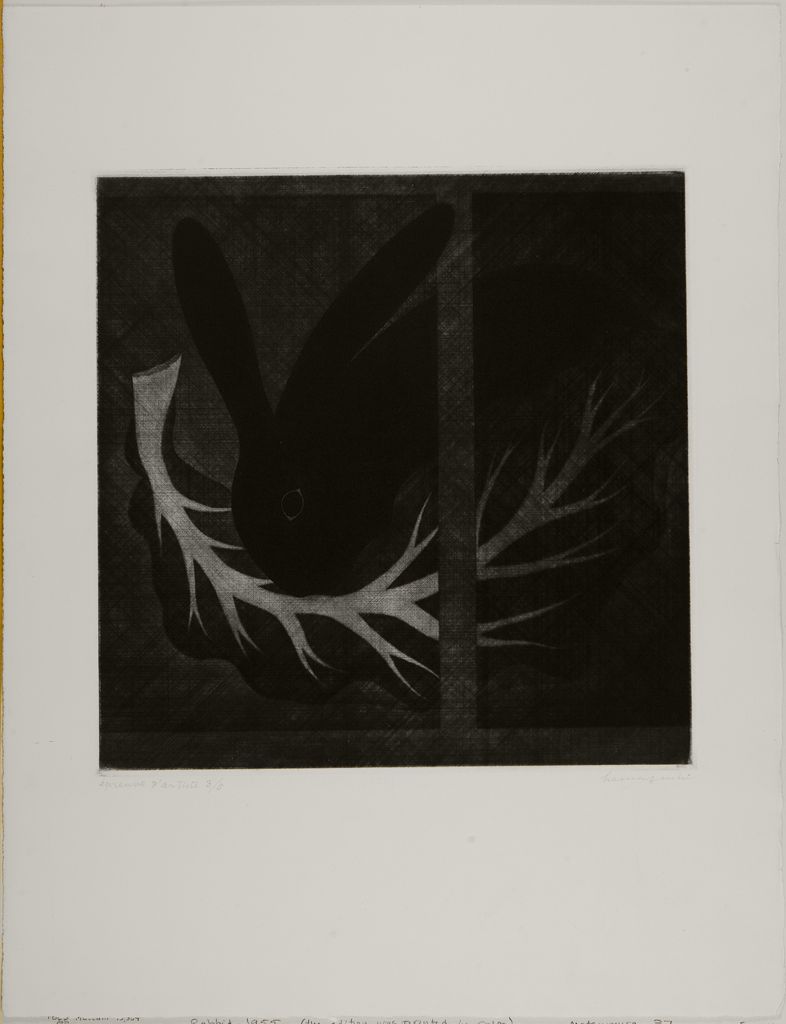
Rabbit, 1955
Woodblock print
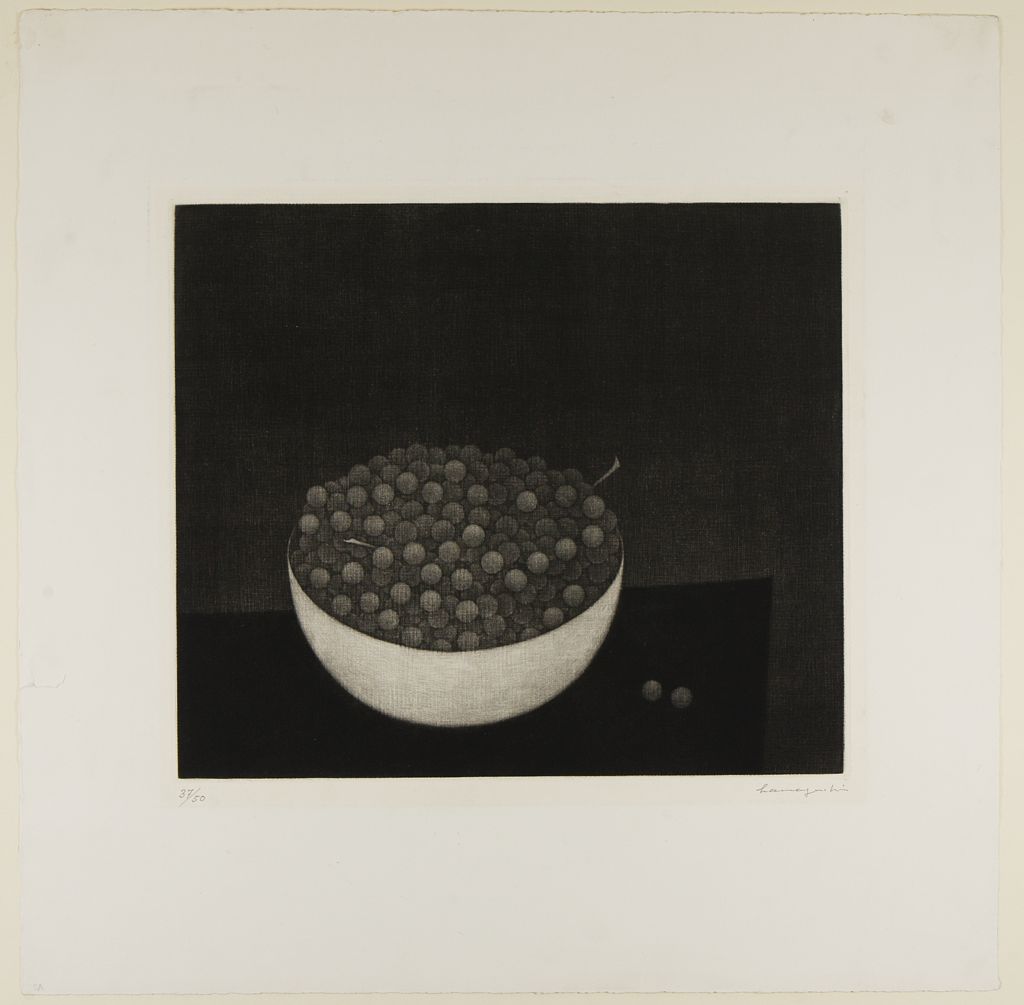
Grapes, 1955
Woodblock print
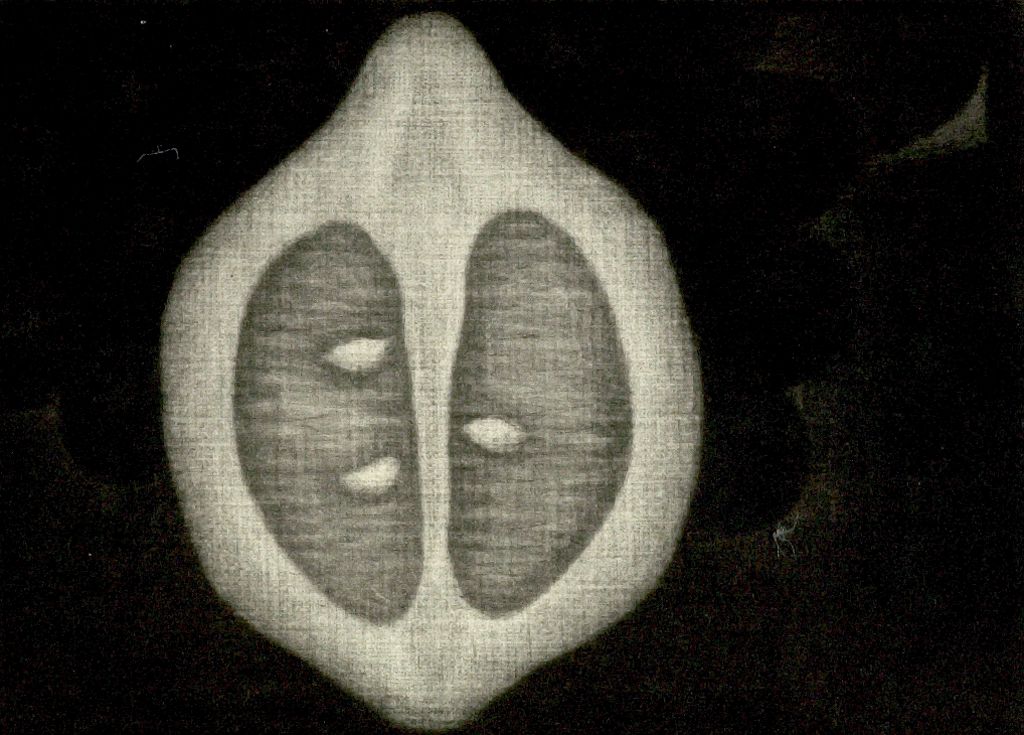
Lemon (Holiday Card from Yamanaka, 1956), Shôwa period, dated 1959
Woodblock print
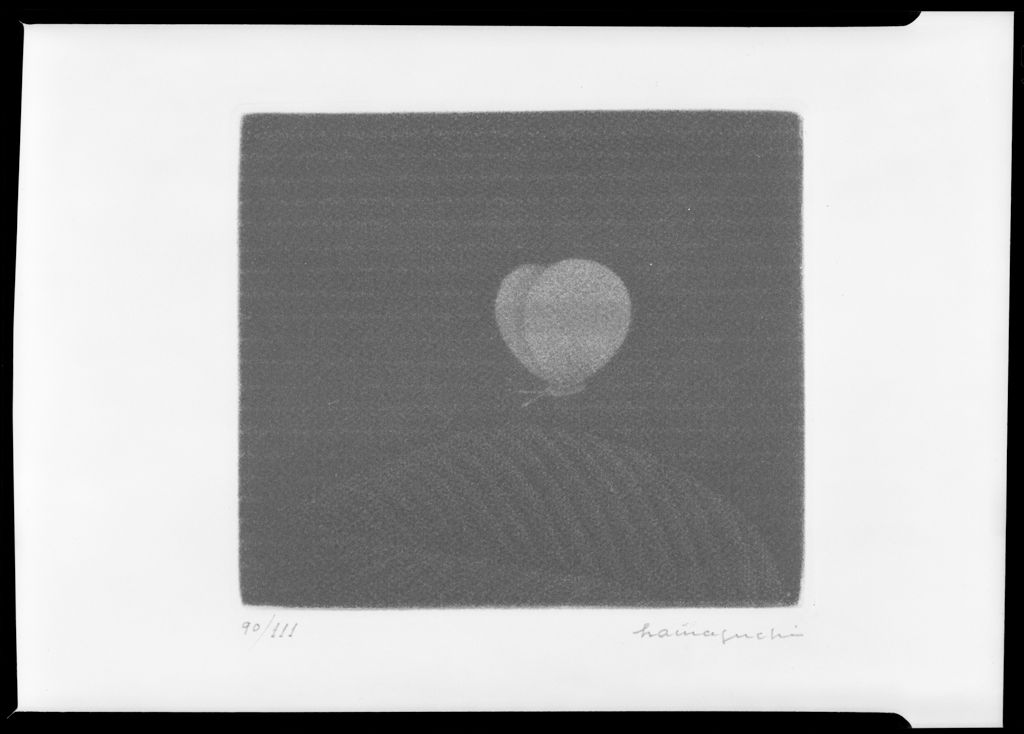
Leaf and Butterfly, Shôwa period, dated 1972
Woodblock print
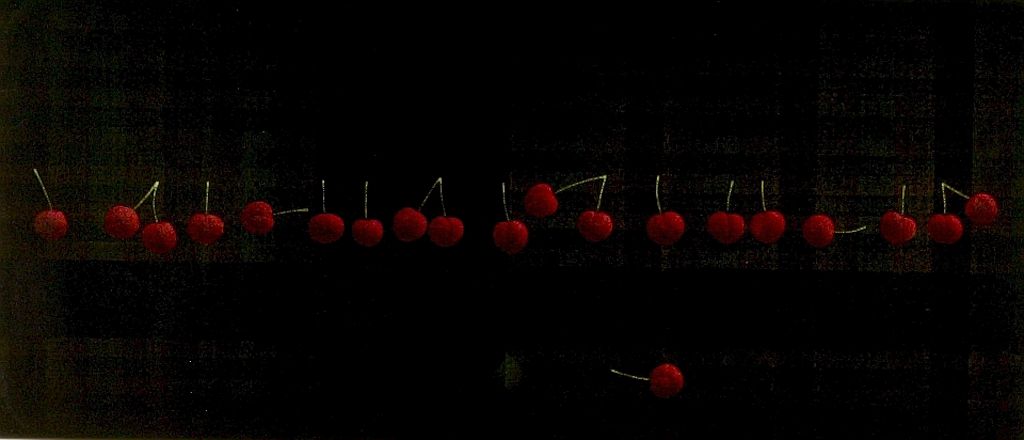
Hamaguchi Yozo (1909-2000)
Woodblock print