Biography
Tetsuro Komai (駒井哲郎, 1920–1976) was a Japanese printmaker recognized as one of the foremost masters of copperplate etching in postwar Japan. Unlike the majority of sosaku-hanga artists who worked with woodblocks, Komai devoted his career to intaglio techniques — etching, aquatint, drypoint, and engraving — producing prints of remarkable technical refinement and imaginative depth that placed him among the most accomplished printmakers of his generation.
Born in 1920 in Tokyo, Komai showed artistic aptitude from an early age and entered the Tokyo School of Fine Arts (now Tokyo University of the Arts), where he studied under the painter Fujishima Takeji. During his student years, he became fascinated with the possibilities of copperplate printmaking, a medium that was still relatively uncommon in Japan, where the woodblock tradition dominated. Komai's decision to specialize in intaglio techniques was a bold one that required him to master a set of skills largely outside the mainstream of Japanese printmaking education.
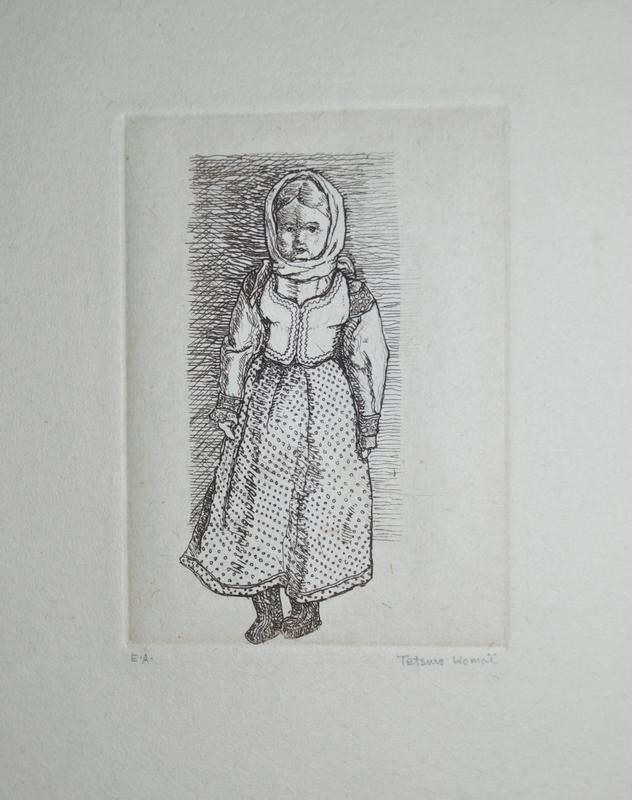
Komai's early work shows the influence of European surrealism, particularly the prints of Giorgio Morandi, Paul Klee, and the dreamlike imagery of the surrealist movement. His etchings from the 1940s and 1950s feature enigmatic, semi-abstract compositions populated by biomorphic forms, architectural fragments, and mysterious landscapes that suggest interior psychological states rather than external reality. The fine, precise lines of his etching needle created images of extraordinary delicacy, with networks of hatching and cross-hatching building tonal passages of considerable complexity.
As his career progressed, Komai developed an increasingly personal visual language that combined abstract and surrealist elements with a poetic sensibility deeply rooted in Japanese aesthetics. His mature prints often evoke the quality of Japanese ink painting — spare, evocative compositions in which a few precisely placed marks suggest vast spaces and subtle atmospheric conditions. The abstraction in his work is never purely formal; it always carries an emotional and imaginative charge that invites the viewer into a contemplative engagement with the image.
Technically, Komai was a virtuoso of the copper plate. He employed a wide range of intaglio methods — line etching for precise drawing, aquatint for tonal areas, drypoint for rich, velvety blacks, and various experimental techniques for textural effects — often combining multiple methods in a single plate. His printing was equally refined, with carefully controlled inking and wiping that brought out the full range of tonal values from the plates. The resulting prints demonstrate a mastery of the intaglio medium that rivals that of any twentieth-century European printmaker.
Komai was also an influential teacher and advocate for printmaking in Japan. He taught at several institutions, including Tokyo University of the Arts, where he trained a generation of younger printmakers and helped elevate the status of intaglio printmaking within the broader Japanese art world. His writings on printmaking technique and aesthetics contributed to a deeper understanding of the medium among Japanese artists and collectors.
Komai died in 1976 at the age of fifty-six, his career cut short by illness. Despite the relatively brief span of his active career, he produced a substantial body of etchings that established him as one of the most important Japanese printmakers of the twentieth century. His work is held in major collections, including the National Museum of Modern Art in Tokyo, the Museum of Modern Art in New York, the British Museum, and the Bibliothèque Nationale de France.
Key Facts
- Active Period
- 1920–1976
- Nationality
- 🇯🇵Japan
- Movement
- Sōsaku-hanga
- Works Indexed
- 3
Frequently Asked Questions
What is Tetsuro Komai known for?
Tetsuro Komai (駒井哲郎, 1920–1976) was a Japanese printmaker recognized as one of the foremost masters of copperplate etching in postwar Japan. Unlike the majority of sosaku-hanga artists who worked with woodblocks, Komai devoted his career to intaglio techniques — etching, aquatint, drypoint, and engraving — producing prints of remarkable technical refinement and imaginative depth that placed him among the most accomplished printmakers of his generation.
When was Tetsuro Komai active?
Tetsuro Komai was active from 1920 to 1976. They were associated with the Sōsaku-hanga movement.
What artistic movements influenced Tetsuro Komai?
Tetsuro Komai's work was shaped by the Sōsaku-hanga tradition in Japanese woodblock printmaking. Sōsaku-hanga: The "creative prints" movement (c.
Where can I see Tetsuro Komai's original prints?
Original prints by Tetsuro Komai can be found in collections including ukiyo-e.org, Minneapolis Institute of Art.
How much do Tetsuro Komai prints cost?
Tetsuro Komai is recognized as the foremost master of copperplate etching in postwar Japan, and his prints command respect and steady prices among collectors of Japanese and international printmaking. His work in intaglio rather than woodblock gives it a distinctive character that appeals to collectors who appreciate the tonal subtlety and linear precision of etching. Komai's prints appear at auction primarily in the Japanese market, though examples also surface at international print auctions. His relatively early death at age fifty-six means his total output is smaller than that of longer-lived contemporaries, which supports prices. The surrealist-influenced works from the 1950s-1960s and the more abstract mature prints from the 1960s-1970s are equally collected. His work represents strong value for collectors interested in postwar Japanese printmaking beyond the woodblock tradition. His technical mastery is universally acknowledged, and his prints offer a window into the rich but less well-known world of Japanese intaglio printmaking. Smaller works: $300–$800. Mature etchings: $1,200–$3,000. Major works: $4,000–$8,000.