Biography
Paul Jacoulet (1896-1960) was a French-born artist who became one of the most remarkable and unusual figures in the history of Japanese woodblock printmaking. Although European by birth, Jacoulet spent virtually his entire life in Japan and the Pacific Islands, creating a body of work that occupies a unique position at the intersection of Western and Japanese artistic traditions. His luminously colored prints depicting the peoples of Micronesia, Korea, China, Japan, and other regions of East Asia and the Pacific are among the most distinctive and beautiful works produced in the shin-hanga style, notable for their ethnographic sensitivity, technical perfection, and sumptuous use of color.
Jacoulet was born on November 28, 1896, in Paris, France, but his family moved to Tokyo when he was only three years old. His father was a professor of French at the Gakushuin (Peers' School), and young Paul grew up immersed in Japanese culture, language, and artistic traditions from his earliest memories. He attended Japanese schools, became fluent in Japanese, and developed a deep affinity for Japanese art and aesthetics that would define his entire career. In many respects, Jacoulet was culturally Japanese despite his French parentage, and this bicultural identity — at home in both Western and Japanese artistic worlds — gave his work its distinctive character.
As a young man, Jacoulet studied painting and drawing, developing exceptional skills in both Western and Japanese techniques. He was particularly drawn to the tradition of Japanese woodblock printing, and he studied the methods of the ukiyo-e masters as well as the contemporary shin-hanga movement then being championed by the publisher Watanabe Shozaburo. However, unlike most shin-hanga artists who worked with commercial publishers, Jacoulet chose to produce his prints independently, maintaining complete control over every aspect of the creative process. He employed his own team of master carvers and printers, working closely with them to achieve the extraordinary level of technical refinement for which his prints are renowned.
Jacoulet's artistic vision was shaped by extensive travel throughout East Asia and the Pacific Islands. Beginning in the 1920s, he made numerous journeys to Korea, Manchuria, China, and the islands of Micronesia — particularly the Mariana Islands, the Caroline Islands, and Palau, which were then under Japanese mandate. These travels provided the subject matter for the great majority of his prints: portraits of the indigenous peoples he encountered, depicted with a combination of ethnographic precision and aesthetic idealization that reflects both his Western training in portraiture and his Japanese-influenced sense of design and color.
His first major series of prints appeared in the 1930s, and over the following decades he produced approximately 166 designs, each printed in strictly limited editions of 350 impressions. This limited-edition approach was unusual in the world of Japanese printmaking, where editions were typically open-ended, and it reflected Jacoulet's understanding of the Western art market's valuation of scarcity. Each print was numbered, signed with his distinctive red personal seal (designed in the style of a Japanese hanko), and produced to the highest possible standards of craftsmanship.
Among Jacoulet's most celebrated works is "Champagne Rose" (La Rose de Champagne), a striking portrait of a Japanese woman holding a pink champagne rose, which exemplifies his ability to merge Japanese aesthetic sensibility with a Western eye for naturalistic beauty. Other notable prints include "The Pearls" (Les Perles), depicting a Micronesian woman stringing pearls; "The Bride, Seoul, Korea" (La Mariée, Séoul, Corée), showing a Korean woman in traditional wedding attire; and numerous portraits of Micronesian, Chamorro, and Palauan subjects that document traditional clothing, ornaments, tattooing practices, and cultural customs that were rapidly disappearing under the pressures of modernization.
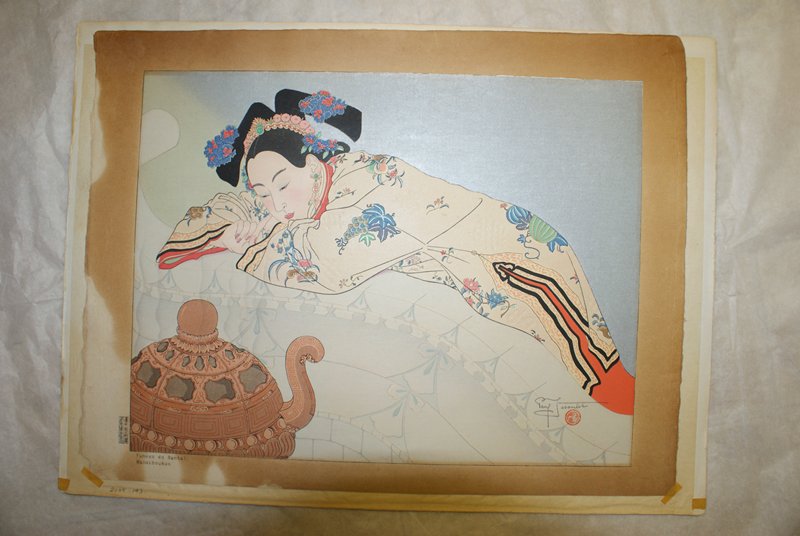
The technical quality of Jacoulet's prints is extraordinary, even by the high standards of shin-hanga. His carvers and printers were among the most skilled in Japan, and the printing process for each design typically involved dozens of separate color blocks, with extensive use of embossing (karazuri), metallic pigments (gold and silver), and other special techniques. The papers used were of the finest handmade washi, often treated with mica or other materials to achieve specific textural effects. The colors in Jacoulet's prints are remarkable for their vibrancy and subtlety, ranging from the rich browns and earth tones of Micronesian skin to the delicate pinks and lavenders of floral elements, all achieved through careful mixtures of mineral and vegetable pigments applied in multiple impressions.
Jacoulet's prints also have significant ethnographic value. His depictions of Pacific Island peoples, created during a period when traditional cultures were under tremendous pressure from colonial administration and modernization, constitute an invaluable visual record of ways of life that have since largely disappeared. His portraits of tattooed Palauan women, Chamorro dancers, and Yapese chiefs wearing traditional clothing and ornaments document cultural practices with a sympathetic attentiveness that was rare among Western observers of his era. While his approach was inevitably shaped by the aesthetic conventions of his time, his genuine respect for his subjects and his meticulous attention to cultural detail give his work a documentary significance that extends beyond its purely artistic merits.
During World War II, Jacoulet remained in Japan, and his work was interrupted by the conflict. After the war, he resumed printmaking and continued to produce new designs until his death. His prints were widely collected by American servicemen stationed in Japan during the occupation, which established a strong collector base for his work in the United States. This market has continued to grow, and Jacoulet's prints are now among the most collected works of twentieth-century Japanese printmaking outside Japan.
Jacoulet's artistic legacy is unique. As one of the very few non-Japanese artists to work successfully within the Japanese woodblock print tradition, he demonstrated that the medium could accommodate subjects and sensibilities far beyond its traditional boundaries while retaining its essential technical and aesthetic qualities. His prints bridge cultures — French and Japanese, Western and Pacific Island — in ways that remain compelling and relevant. He died on March 9, 1960, in Karuizawa, Japan, the country that had been his home since early childhood. His work is represented in numerous museum collections, including the Honolulu Museum of Art (which holds the largest public collection of his prints), the Musée du quai Branly in Paris, the Tokyo National Museum, and the Pacific Island Museum in Guam.
Key Facts
- Active Period
- 1896–1960
- Nationality
- 🇫🇷France
- Movement
- Shin-hanga
- Works Indexed
- 91
Frequently Asked Questions
What is Paul Jacoulet known for?
Paul Jacoulet (1896-1960) was a French-born artist who became one of the most remarkable and unusual figures in the history of Japanese woodblock printmaking. Although European by birth, Jacoulet spent virtually his entire life in Japan and the Pacific Islands, creating a body of work that occupies a unique position at the intersection of Western and Japanese artistic traditions. His luminously colored prints depicting the peoples of Micronesia, Korea, China, Japan, and other regions of East Asia and the Pacific are among the most distinctive and beautiful works produced in the shin-hanga style, notable for their ethnographic sensitivity, technical perfection, and sumptuous use of color.
When was Paul Jacoulet active?
Paul Jacoulet was active from 1896 to 1960. They were associated with the Shin-hanga movement.
What artistic movements influenced Paul Jacoulet?
Paul Jacoulet's work was shaped by the Shin-hanga tradition in Japanese woodblock printmaking. Shin-hanga: The "new prints" movement (c.
What subjects did Paul Jacoulet depict?
Paul Jacoulet's prints frequently feature portraits, landscapes, urban scenes, birds & flowers, night scenes, temples & shrines.
Where can I see Paul Jacoulet's original prints?
Original prints by Paul Jacoulet can be found in collections including Victoria and Albert Museum, japancoll, Fine Arts Museums of San Francisco, Japanese Art Open Database.
How much do Paul Jacoulet prints cost?
Paul Jacoulet prints are unique in the world of Japanese woodblock printing. A French artist who grew up in Japan and lived most of his life in Tokyo, Jacoulet created exquisitely detailed prints depicting the peoples and cultures of the Pacific Islands, Korea, China, and Japan. His self-published limited editions of approximately 150 impressions each are the standard collectible format. Prices generally range from $500 for common subjects to $5,000–$8,000 for rare and popular designs. All of Jacoulet's prints were self-published in numbered editions of approximately 150 copies, printed under his direct supervision by master printers. There are no posthumous editions from his blocks. Each print is signed in pencil, numbered, and bears his personal seal. The hallmarks of Jacoulet's technique are the liberal use of mica (kirazuri) backgrounds, metallic pigments (gold and silver leaf), and gauffrage (blind embossing), all of which make his prints instantly recognizable. Look for the shimmer of mica on the background and the raised texture of embossed details as markers of quality impressions. His most sought-after subjects are the portraits of Micronesian and Melanesian figures, which combine anthropological documentation with artistic beauty. Korean and Chinese subjects also command strong prices. Common subjects from later printings: $500–$1,200. Popular subjects in fine condition: $1,500–$3,500. Rare subjects or early impressions with vibrant mica and metallic pigments: $3,500–$8,000. Condition is critical because the mica and metallic elements are susceptible to flaking and abrasion — prints retaining their full surface effects are worth significantly more.