Biography
Lilian May Miller (1895–1943) was an American artist and printmaker who holds the distinction of being one of the first Western women to master the Japanese woodblock printing technique, creating a body of work that sensitively depicted the landscapes and people of Korea and Japan. Born and raised in Asia as the daughter of an American diplomat, Miller occupied a unique position between Eastern and Western artistic traditions, producing prints that combined Japanese technical methods with a Western painter's approach to composition and atmosphere.
Born on July 20, 1895, in Tokyo, Japan, Miller was the daughter of Ransford Stevens Miller Jr., who served as the American diplomatic consul in various Asian postings. She grew up immersed in East Asian culture, spending her formative years in Tokyo, Seoul, and other Asian cities. This bicultural upbringing gave her an intimate familiarity with Japanese and Korean art, architecture, and landscape that would distinguish her printmaking from that of Western artists who encountered Asian art only as adults.
Miller's artistic training was equally divided between East and West. She studied Japanese painting under Shimada Bokusen, a nihonga painter, and learned the fundamentals of woodblock carving and printing from Japanese craftsmen. She also received Western art training, studying briefly at Vassar College and exhibiting her work in the United States and Europe. This dual education equipped her with an unusual breadth of technical skills and aesthetic perspectives.
What set Miller apart from most other Western practitioners of Japanese woodblock printing was that she carved and printed her own blocks. Unlike the shin-hanga artists who worked within the collaborative publisher model — providing designs that professional carvers and printers executed — Miller followed the sosaku-hanga ideal of the artist as sole creator, designing, carving, and printing each work herself. This hands-on approach gave her prints a directness and personal quality that distinguished them from the polished productions of the Watanabe studio.
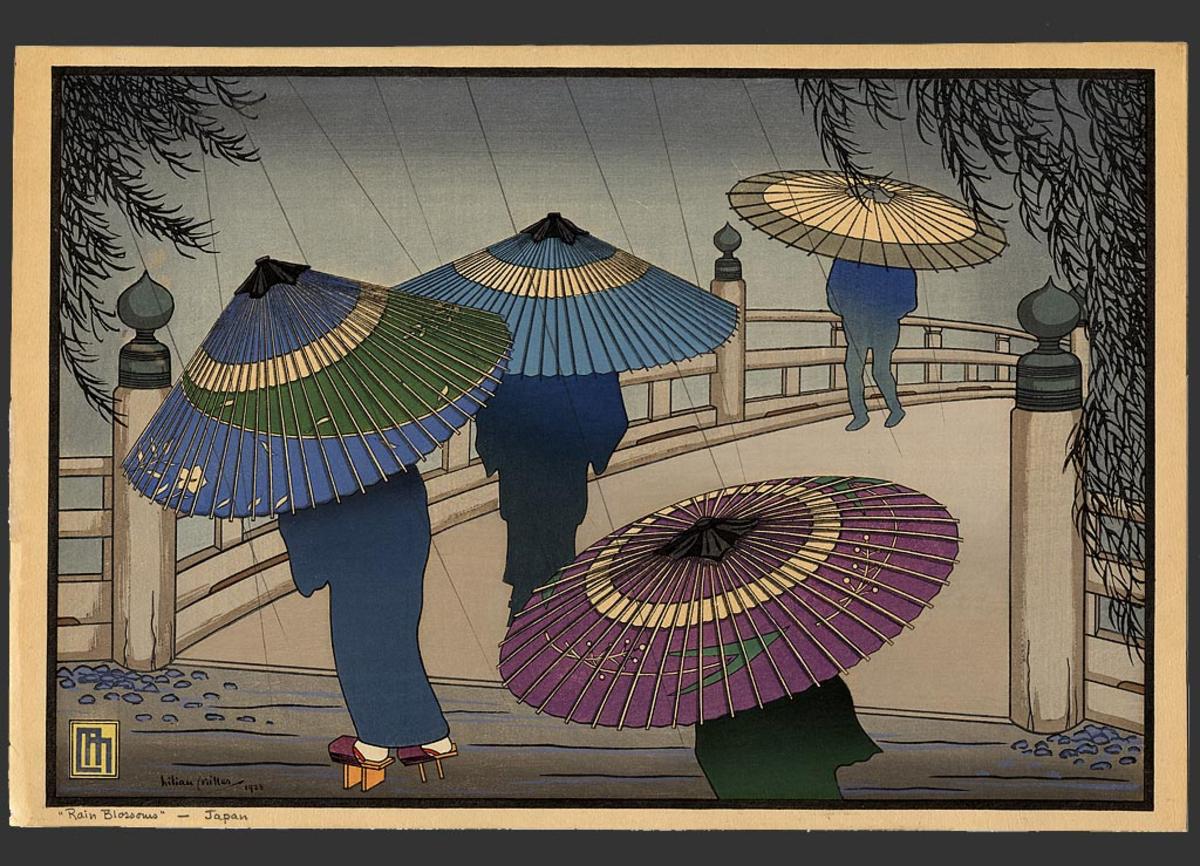
Miller's subjects were drawn primarily from Korea and Japan. Her Korean prints, depicting thatched-roof villages, pine-covered mountains, palace gates, and figures in traditional Korean dress, are among the earliest and most sensitive Western artistic portrayals of Korea. Works such as "Rain Blossoms, Korea" and "Korean Dancers" capture scenes of traditional Korean life with an affection and understanding that reflected her years of residence in the country. Her Japanese subjects included landscapes, garden scenes, and views of temples and shrines, rendered with the same combination of Eastern technique and Western compositional sense.
Miller's printing technique was distinctive. She favored a relatively limited palette, often building her compositions from subtle gradations of a few key colors. Her bokashi effects tend toward soft, atmospheric transitions rather than the dramatic contrasts favored by some shin-hanga artists. The texture of her printing — slightly uneven, with visible evidence of the hand — gives her work an artisanal warmth that contrasts with the smoother finish of commercially published prints.
Throughout the 1920s and 1930s, Miller exhibited widely, showing her prints at galleries and museums in the United States, Japan, and Europe. She was a regular exhibitor at the Society of American Graphic Artists and participated in major print exhibitions. Her work was well received by critics, who recognized the unusual combination of Eastern technique and Western sensibility in her prints.
Miller's life was cut short when she died in 1943 at the age of forty-seven. Her relatively small body of woodblock prints — perhaps a hundred or so designs — has attracted growing collector interest in recent decades as her unique contribution to the history of Japanese-influenced Western printmaking has been more widely recognized. Her prints are held in collections including the Library of Congress, the Smithsonian American Art Museum, the Honolulu Museum of Art, and the Tokyo National Museum.
Key Facts
- Active Period
- 1895–1943
- Nationality
- 🇺🇸United States
- Movement
- Shin-hanga
- Works Indexed
- 10
Frequently Asked Questions
What is Lilian May Miller known for?
Lilian May Miller (1895–1943) was an American artist and printmaker who holds the distinction of being one of the first Western women to master the Japanese woodblock printing technique, creating a body of work that sensitively depicted the landscapes and people of Korea and Japan. Born and raised in Asia as the daughter of an American diplomat, Miller occupied a unique position between Eastern and Western artistic traditions, producing prints that combined Japanese technical methods with a Western painter's approach to composition and atmosphere.
When was Lilian May Miller active?
Lilian May Miller was active from 1895 to 1943. They were associated with the Shin-hanga movement.
What artistic movements influenced Lilian May Miller?
Lilian May Miller's work was shaped by the Shin-hanga tradition in Japanese woodblock printmaking. Shin-hanga: The "new prints" movement (c.
Where can I see Lilian May Miller's original prints?
Original prints by Lilian May Miller can be found in collections including ukiyo-e.org, Japanese Art Open Database, Scholten Japanese Art.
How much do Lilian May Miller prints cost?
Lilian May Miller's woodblock prints occupy a unique niche as the work of one of the first Western women to master Japanese printmaking techniques. She carved and printed all her own blocks, producing small editions of 50 to 100 impressions. Her prints are genuinely scarce, and her Korean subjects are especially sought after by collectors interested in historical depictions of Korea. Most prints sell in the $1,500-$5,000 range. Miller's prints are signed in pencil, and there are no posthumous editions since she carved her own blocks. The quality of individual impressions varies because she handled all production herself — the finest examples show crisp lines and vibrant, evenly applied color. Condition is particularly important given the small edition sizes and the difficulty of finding replacements. Her Korean subjects command the strongest prices, as they represent some of the earliest and most sensitive Western artistic depictions of Korea. Japanese landscapes and garden scenes are also collectible but generally sell for somewhat less. Miller's market has grown steadily as her historical significance has become more widely appreciated, particularly among collectors of Western artists who worked in Japanese printmaking traditions.
Woodblock Prints by Lilian May Miller (10)
No Series Rain Blossoms
Woodblock print
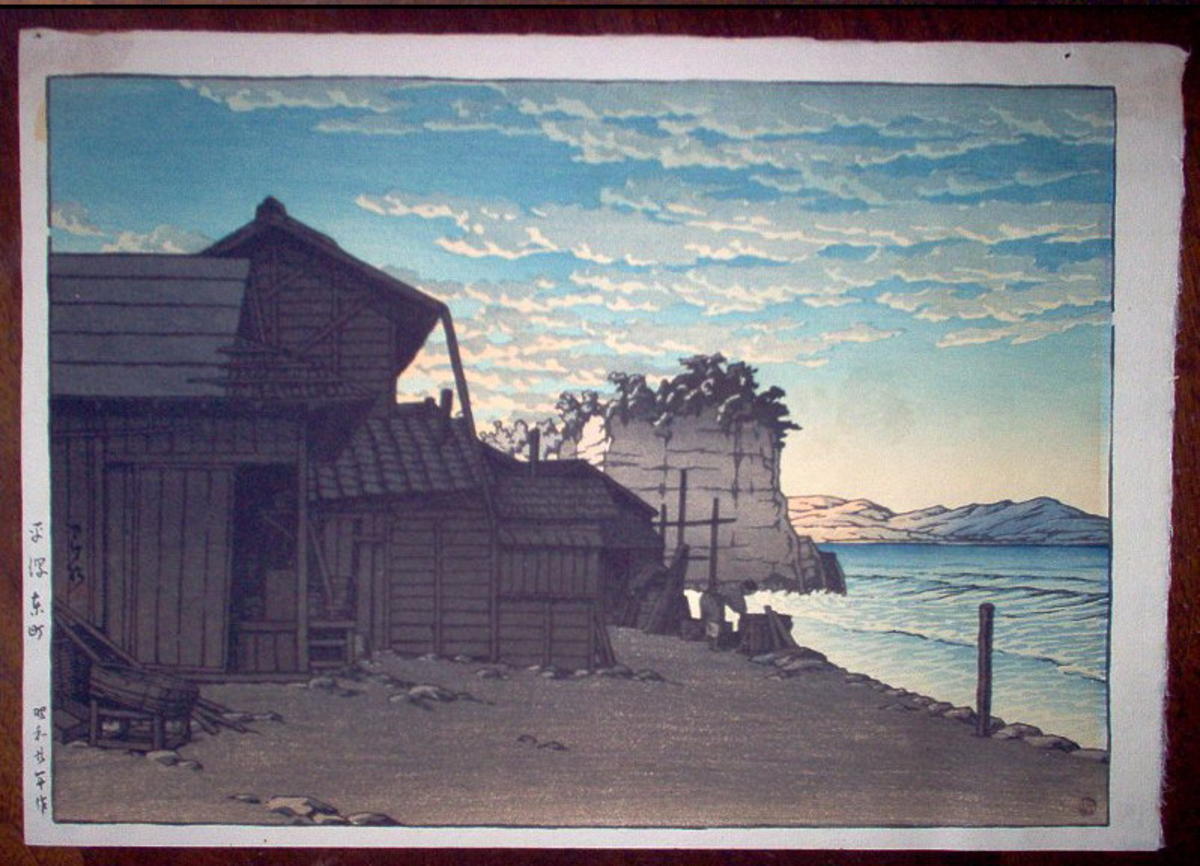
Kawase Hasui No Series Higashi Hirakata
Woodblock print

No Series Moonlight On Fujiyama Japan
Woodblock print
Lillian Miller
Woodblock print
Higashi- Hirakata
Woodblock print
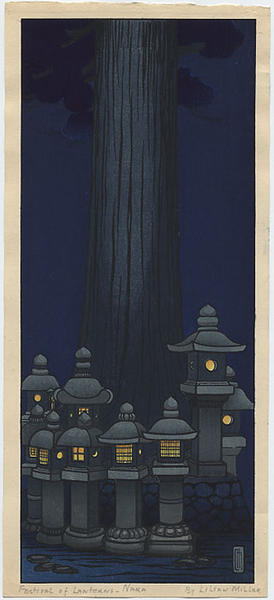
Festival of Lanterns - Nara
Woodblock print
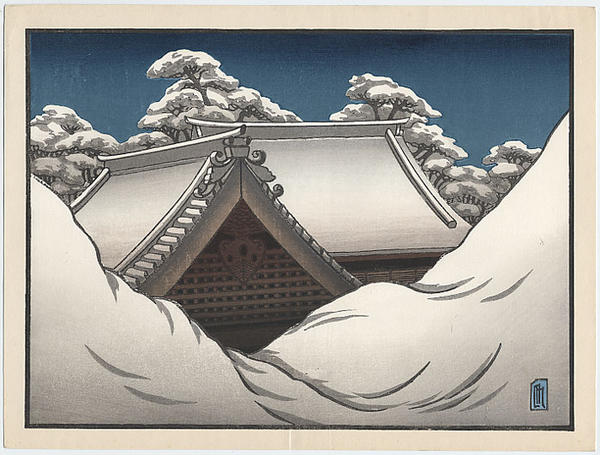
Snow on Temple Roofs
Woodblock print
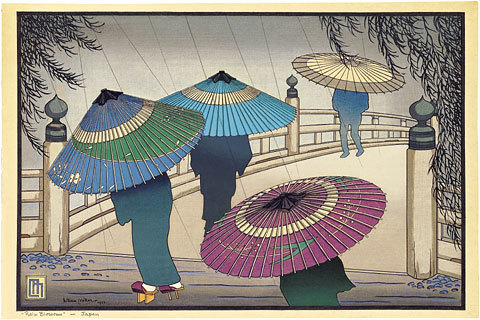
Lilian May Miller
Woodblock print
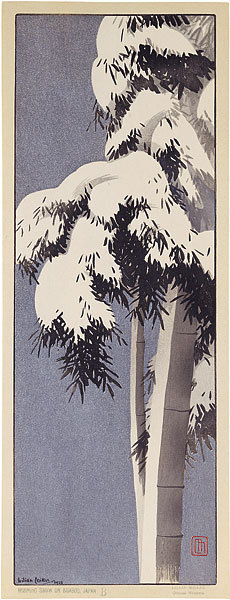
Morning Snow on Bamboo (B)
Woodblock print
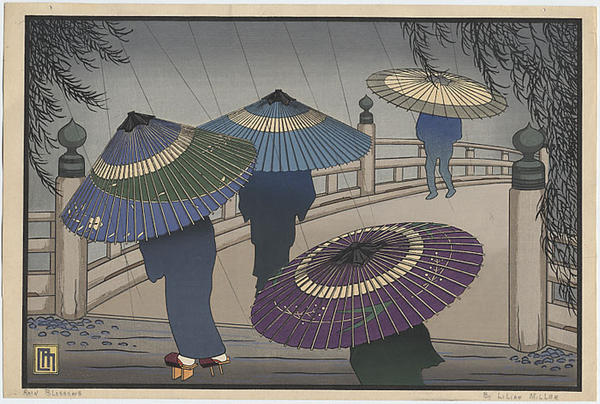
Untitled (lilian-may-miller)
Woodblock print