
Biography
Katsunori Hamanishi (浜西勝則, born 1949) is a Japanese printmaker widely regarded as one of the world's leading contemporary practitioners of the mezzotint technique. His extraordinarily detailed prints of natural subjects — leaves, feathers, shells, insects, and botanical specimens — achieve a level of precision and luminosity that pushes the mezzotint medium to the limits of its expressive capabilities. Working in a tradition that stretches back to the seventeenth century and was revitalized in the twentieth century by his compatriot Yozo Hamaguchi, Hamanishi has established himself as a master of this demanding and painstaking art form.
Born in 1949 in Osaka, Japan, Hamanishi studied at the Musashino Art University in Tokyo, where he trained in printmaking and developed his fascination with intaglio techniques. He was drawn to mezzotint — a process that begins with the laborious rocking of a serrated tool across the copper plate to create a uniform burr, then proceeds through the even more painstaking process of burnishing and scraping to create the image — by the medium's unparalleled capacity for rendering fine detail and subtle tonal gradation.
Hamanishi's mature work is characterized by its breathtaking technical precision and its choice of natural specimens as subjects. His mezzotints of individual leaves are perhaps his most celebrated works: each leaf is rendered with a fidelity that records every vein, every subtle color variation, every imperfection of edge and surface, yet the overall effect transcends mere illustration to achieve a kind of reverent contemplation of natural form. The leaves appear to float in pools of velvety darkness, their surfaces glowing with an inner light that the mezzotint technique, uniquely among printmaking methods, is able to produce.
Beyond leaves, Hamanishi has created mezzotints of feathers, shells, butterflies, dragonflies, and other natural objects, each rendered with the same extraordinary attention to detail. His prints of feathers, in particular, demonstrate the mezzotint's capacity for rendering the most delicate textures — each barb and barbule of the feather is individually articulated, creating surfaces of astonishing complexity and beauty. His shell prints explore the geometries and textures of molluscan architecture with equal precision.
The technical achievement represented by Hamanishi's prints is formidable. The mezzotint process is among the most time-consuming and physically demanding of all printmaking techniques, and the level of detail in his prints requires weeks or months of patient work on each plate. The burnishing and scraping that creates the image must be executed with absolute precision, as any error is difficult or impossible to correct. The printing of each impression is equally demanding, requiring careful inking and wiping to bring out the full range of tonal values from the plate.
Hamanishi has exhibited extensively in Japan and internationally, receiving awards at major print exhibitions and biennials. His work has been shown in solo exhibitions at galleries and museums in Tokyo, New York, London, and other cities. He is recognized by collectors and curators as a leading figure in contemporary mezzotint printmaking, carrying forward a tradition that has been revitalized largely through the efforts of Japanese artists.
His prints are held in collections including the British Museum, the National Museum of Modern Art in Tokyo, the New York Public Library, the Bibliothèque Nationale de France, and numerous other institutions worldwide. Now in his mid-seventies, Hamanishi continues to produce mezzotints of exceptional quality, maintaining the exacting standards that have defined his career.
Key Facts
- Active Period
- 1949
- Nationality
- 🇯🇵Japan
- Movements
- Contemporary MokuhangaSōsaku-hanga
- Works Indexed
- 41
Frequently Asked Questions
What is Katsunori Hamanishi known for?
Katsunori Hamanishi (浜西勝則, born 1949) is a Japanese printmaker widely regarded as one of the world's leading contemporary practitioners of the mezzotint technique. His extraordinarily detailed prints of natural subjects — leaves, feathers, shells, insects, and botanical specimens — achieve a level of precision and luminosity that pushes the mezzotint medium to the limits of its expressive capabilities. Working in a tradition that stretches back to the seventeenth century and was revitalized in the twentieth century by his compatriot Yozo Hamaguchi, Hamanishi has established himself as a master of this demanding and painstaking art form.
When was Katsunori Hamanishi active?
Katsunori Hamanishi was active born in 1949. They were associated with the Contemporary Mokuhanga and Sōsaku-hanga movements.
What artistic movements influenced Katsunori Hamanishi?
Katsunori Hamanishi's work was shaped by the Contemporary Mokuhanga and Sōsaku-hanga traditions in Japanese woodblock printmaking. Contemporary Mokuhanga: Contemporary mokuhanga (literally "wood-block print") encompasses artists working from approximately 1970 to the present who continue or reinvent traditional Japanese woodblock printing techniques. Sōsaku-hanga: The "creative prints" movement (c.
Where can I see Katsunori Hamanishi's original prints?
Original prints by Katsunori Hamanishi can be found in collections including Art Institute of Chicago, Victoria and Albert Museum, Japanese Art Open Database, Minneapolis Institute of Art.
How much do Katsunori Hamanishi prints cost?
Katsunori Hamanishi is recognized as one of the world's leading contemporary mezzotint artists, and his extraordinarily detailed prints of natural subjects command strong prices among collectors of fine printmaking. His work appeals to collectors who appreciate both supreme technical mastery and the beauty of natural forms rendered with reverent precision. Hamanishi's small edition sizes and the labor-intensive nature of mezzotint ensure limited supply. Early impressions from each plate, which show the finest detail and richest tones, are the most desirable. His leaf prints are the most iconic and popular, followed by feathers, shells, and insect subjects. As a living artist with growing international recognition, Hamanishi's market has shown steady appreciation. His prints offer collectors access to mezzotint work of the highest quality at prices that remain moderate relative to historical masters of the medium. Smaller works: $800–$1,500. Standard leaf and feather prints: $2,000–$5,000. Major works: $6,000–$12,000.
Woodblock Prints by Katsunori Hamanishi (41)
Setsugo (Joining Together)—Circle, Square, Triangle
1978
Mezzotint

Setsugo (Joining Together)—A
1978
Mezzotint

Combination—Curve #1
1978
Mezzotint

Combination—Twist #1
1978
Mezzotint

Variation—Cross #2
1979
Mezzotint

Object—Rope #7
1980
Mezzotint

Correlation—Work #3
1982
Mezzotint

So Tai (Relativity)—Work #7
1982
Mezzotint

Round Trip
1983
Mezzotint

Game—Work #6
1983
Mezzotint
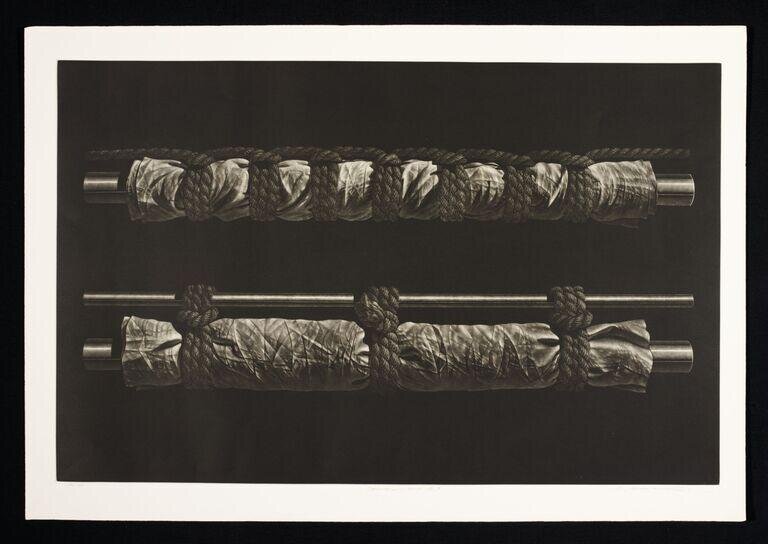
Opposition - Work no. 9
ca.1983-84

Round Trip—Work #9
1984
Mezzotint

Situation—Work #4, A.P.
1985
Mezzotint

Crevice - Work No. 2
1987
Mezzotint, ink and color on paper

Crevice-Work #6
1988
Mezzotint

Swing
1989
Mezzotint

Division—Work #12
1989
Mezzotint

Three Subjects of The Meiji Shrine (One Hundred Views of Tokyo, Message to the 21st Century 東京百景 21世紀へのメッセジ)
1989-99

Mizuhiki-Ro—B
1990
Mezzotint

Mizuhiki-Ha—C
1990
Mezzotint

Mizuhiki-Ni—D
1990
Mezzotint

Division—Work #21
1990
Mezzotint

Division—Work #26
1991
Mezzotint

Division—Work #36
1992
Mezzotint

“Flamingo” by Alexander Calder, from the series "Viva Chicago"
1997
Mezzotint

“Monument with Standing Beast” by Jean Dubuffet, from the series "Viva Chicago"
1997
Mezzotint

“The Four Seasons” by Marc Chagall, from the series "Viva Chicago"
1997
Mezzotint

“Miro's Chicago” by Joan Miró, from the series "Viva Chicago"
1997
Mezzotint

The Water Tower, from the series "Viva Chicago"
1997
Mezzotint

Kotobuki
1997
Mezzotint

Corncob by Bertrand Goldberg, from the series "Viva Chicago"
1997
Mezzotint

Chicago Picasso by Pablo Picasso, from the series "Viva Chicago"
1997
Mezzotint
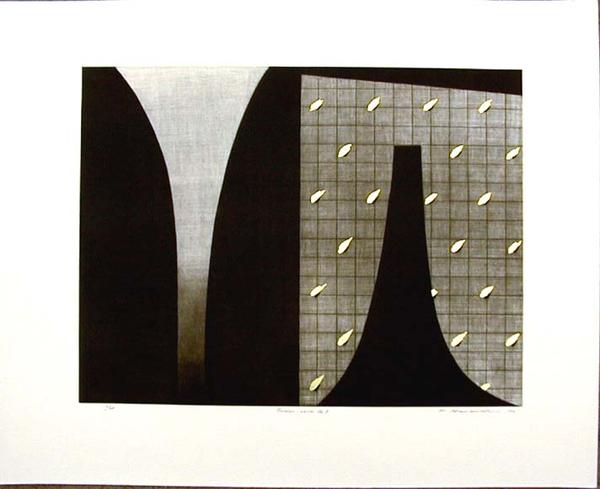
Hamanishi Katsunori
2000
Woodblock print

Window #5
2006
Mezzotint

Origami #1
2008
Mezzotint

Kimono—Four Seasons
2012
Mezzotint triptych

Kimono—Shishi to Ryu (Lion and Dragon)
2012
Mezzotint diptych

Spring - Canola Flowers Field
2022
Color mezzotint on wove paper

Summer - Summer Pond
2022
Mezzotint

Fall - Manzyusyage (Flowers of Heaven)
2022
Mezzotint

Winter - Cold Camellia Road
2022
Mezzotint